
Classical economics is built upon the premise of Homo Economicus: the perfectly rational agent who optimizes their decisions based on utility maximization. However, empirical observation of consumer behavior in corporate corridors and retail trenches reveals a diametrically opposed narrative. Human choices are contextual, relative, and highly susceptible to environmental manipulation. At the core of this cognitive vulnerability operates one of the most lethal tools in modern pricing strategy: the Decoy Effect.
The Architecture of Asymmetric Dominance
The Decoy Effect, known in behavioral economics literature as the Asymmetric Dominance Bias, occurs when a consumer's preference between two original options changes dramatically upon the introduction of a third, asymmetrically dominated option.
An option is asymmetrically dominated when it is inferior in all aspects to one of the original options, but inferior in only some aspects to the other.
The function of this third option is not to be sold. Its existence in the portfolio has a singular, surgical purpose: to alter the consumer's frame of reference and push them, seemingly autonomously, toward the most profitable option for the company. The efficacy of a pricing strategy based on the Decoy Effect lies in the human brain's inherent inability to evaluate absolute values. We evaluate values relatively. We compare what is in front of us.

The Cinema Popcorn Paradigm
To comprehend the mechanics of this phenomenon, we must analyze the most ubiquitous case of its application: the pricing board at cinema concession stands. Historically, cinemas operated with two popcorn options. A small one for value "X" and a large one for value "Y" (usually double the price of the small).
In this binary scenario, the consumer weighs their actual need (appetite) against the financial cost. Many opt for the small, considering the large an unjustifiable excess. Revenue stagnates.
The disruption occurs with the introduction of a pricing strategy intervention: the medium popcorn.
Assume the following architectural price structure:
- Small Popcorn: $ 15.00
- Medium Popcorn: $ 25.00
- Large Popcorn: $ 27.00
When analyzing this new scenario of asymmetric dominance, the consumer rarely chooses the medium. The medium option acts exclusively as the decoy. The consumer's immediate mental calculus is as follows: "The medium costs 25.00, but for only 2.00 more, I get the large. The large is an exceptional deal."
The decoy shifted the consumer's focus. The decision went from "Do I need enough popcorn to justify spending $ 27.00?" to "It is irrational not to pay an additional $ 2.00 to get significantly more product." The perception of value was artificially inflated through relativity.
Behavioral Economics in Decision Centers
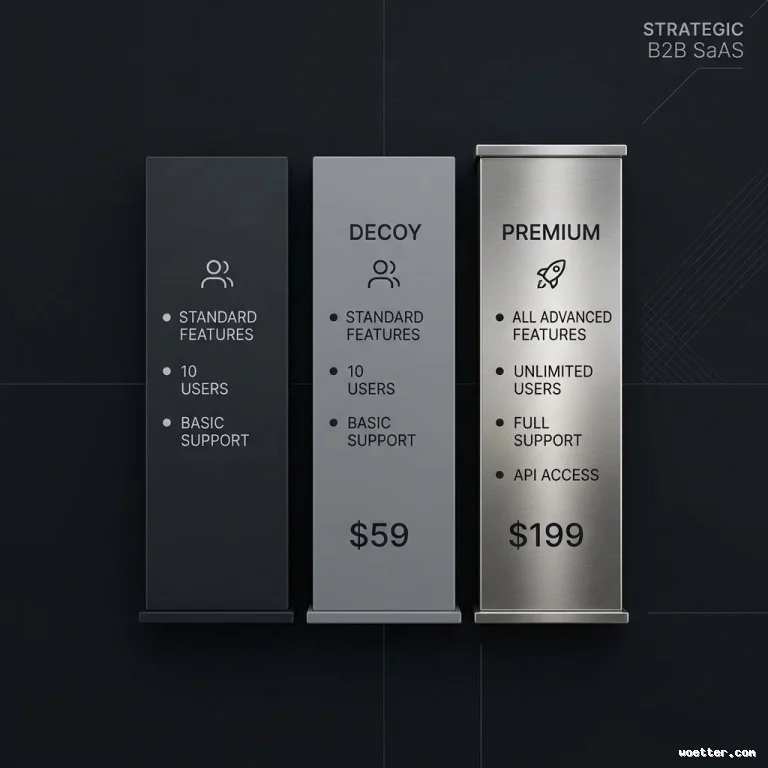
This logic is not restricted to low-ticket retail. In global financial hubs and technology ecosystems, from Silicon Valley to Wall Street, the Decoy Effect is systematically applied in structuring Enterprise contracts and B2B SaaS plans. Account executives frequently present three proposals. The intermediate proposal, often unbalanced in its cost-benefit ratio, exists solely to render the Premium Tier irresistible.
The Economist Case Study
The most celebrated example in business academia regarding the Decoy Effect was documented by researcher Dan Ariely, analyzing the subscription structure of The Economist magazine. The original offer presented three alternatives:
- Digital Subscription: $ 59.00
- Print Subscription: 125.00 3. Digital + Print Subscription: 125.00
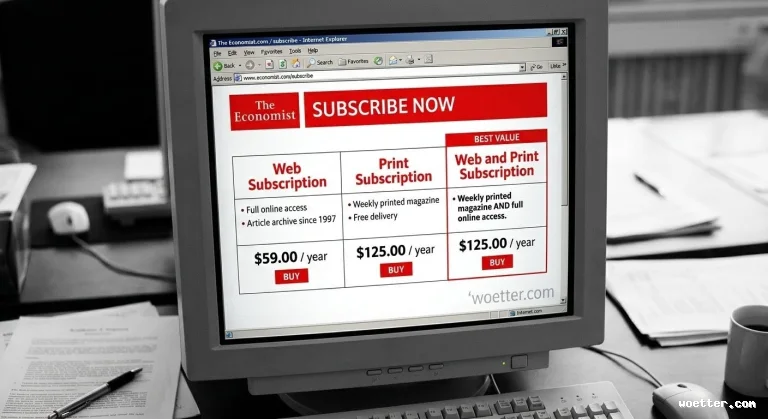
Rationally, option 2 has no market utility. Who would pay $ 125.00 solely for the print version when the exact same amount delivers the comprehensive package? When submitting these options to a group of MIT students, Ariely found that 16% chose the digital, 0% chose the print, and 84% chose the combo (option 3).
Ariely's methodological brilliance was removing the decoy (option 2) and retesting. Without the $ 125.00 print subscription anchoring the value, consumer behavior inverted drastically: 68% opted for the cheaper digital subscription, and only 32% chose the combo.
The mere presence of a useless option increased The Economist's projected revenue by 43%. The asymmetrically dominated option provided the consumer with the rational justification they required to make the more expensive decision, believing they had found a flaw in the pricing system in their favor.
Strategic Implementation in Your Offer
To incorporate the Decoy Effect into your pricing strategy, portfolio engineering must follow strict parameters:
- Target Product Identification: Define which offer yields the highest margin or which plan you intend to represent the overwhelming majority of sales.
- Decoy Creation: Develop an option that is tangibly inferior to the Target Product, but with a price only marginally lower or even equal.
- Asymmetric Positioning: The decoy must be superior to the entry-level option in certain aspects, but clearly inferior to the Target Product in all relevant aspects, forcing direct comparison between the Decoy and the Target.
Success in the contemporary business environment demands abandoning analytical naivety. Price is not a fixed mathematical attribute. Price is a psychological construct. By mastering asymmetric dominance and the Decoy Effect, business leaders cease relying on chance and begin designing the mental corridors through which their clients' purchasing decisions will inevitably flow.
Recommended Reading:
- Predictably Irrational, by Dan Ariely.
- Thinking, Fast and Slow, by Daniel Kahneman.
- Pricing Strategy: Setting Price Levels, Managing Price Discounts and Establishing Price Structures, by Tim Smith.
Your current pricing table is leaving margin on the table. Stop pricing products and start pricing perceptions. Subscribe to our newsletter to receive in-depth dissections on choice architecture and behavioral economics applied to business, delivered straight to your inbox every week.
