
In today's corporate ecosystem, the overwhelming majority of companies suffer from a chronic narrative identity disorder. Upon accessing a standard corporate landing page, the user is immediately bombarded by an arsenal of self-aggrandizement: foundations, awards, technological innovations, and infrastructure. The company places itself center stage. It dresses as the protagonist. What executives fail to comprehend is that the market is not looking for a hero; the market is already full of heroes looking for a guide.
This Brand Positioning failure is what we will define in this essay as the Luke Skywalker Error. Grounded in principles of behavioral economics and narrative frameworks, we will deconstruct why corporate self-exaltation elevates cognitive friction, triggers psychological defenses, and fundamentally destroys both Lifetime Value (LTV) and immediate conversion rates.

The Psychology of Narrative and Status Competition
To grasp the severity of misguided Brand Positioning, we must turn to applied neuroscience. The human brain processes information through narratives of survival and prosperity. The individual — your potential client — wakes up every day as the undisputed protagonist of their own story. They face their own antagonists: inefficiency, time loss, low social status, or financial drain.
When a brand presents itself as the hero (the Luke Skywalker of the transaction), a lethal subconscious phenomenon occurs: the brand and the client enter a direct competition for status within the same narrative.
In any classical storytelling structure, there is no room for two simultaneous heroes. If your company is the hero, the client is demoted to a mere spectator or, worse, a damsel in distress. The neurological response to this is rejection. The Status Quo Bias activates, and the client, feeling their protagonist position threatened or ignored, abandons the interaction. The golden rule of modern Strategic Copywriting is brutal but necessary: your client does not care about your story; they care exclusively about how you can help them win their story.
The Critical Transition: From Protagonist to Guide
The architectural solution for high-performance Brand Positioning is the immediate abandonment of the Luke Skywalker role and the conscious adoption of the Yoda (or Obi-Wan Kenobi) role. The guide. The mentor. The one who possesses the authority, wisdom, and tools (products/services), but whose sole existential purpose is to empower the hero so that they conquer their own conflict.
The Two Non-Negotiable Pillars of the Guide
For a brand to be psychologically accepted as a guide by the consumer, it must simultaneously project two fundamental characteristics, without which trust cannot be established:
- Empathy: The unequivocal demonstration that the company understands the client's pain. It's not about saying "we care"; it's about articulating the client's problem with more precision than they could themselves. The principle of Cognitive Ease dictates that when a brand clearly articulates the pain, the consumer's brain automatically assumes it possesses the solution.
- Authority: The proof of competence. This is where awards, market tenure, and Social Proof come in. However, authority must only be presented after empathy, and strictly as a guarantee that the guide has the technical capacity to lead the hero to victory, not as a vanity trophy.
Case Study: The Reengineering of the Value Proposition
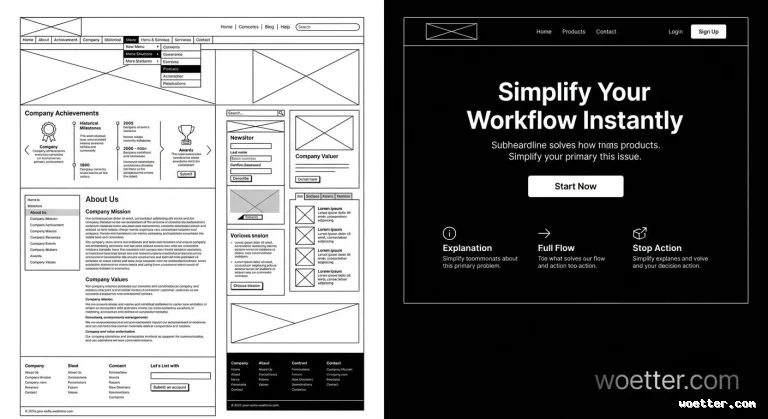
Observe the structural difference and the impact on Conversion Rate Optimization (CRO) when we pivot from company-centric Brand Positioning to Customer Journey-centric positioning.
The Company-Centric Model (The Hero):
- Headline: "The leading accounting platform in North America."
- Sub-headline: "Our proprietary cloud technology features next-generation algorithms and we won the 2025 innovation award. Our servers are secure, and our team is highly qualified."
- Call to Action: "Learn more about us."
The Customer-Centric Model (The Guide):
- Headline: "Spend less time on spreadsheets and more time growing your business."
- Sub-headline: "Automate your financial management in a few clicks with a secure, error-free platform. You focus on your product; we take care of the math."
- Call to Action: "Automate now."
In the first scenario, the brand demands cognitive energy from the user to translate features into benefits. In the second scenario, the brand delivers the final transformation pre-chewed, acting as the vector that empowers the user. The Cognitive Load is reduced to zero.
The Cost of Cognitive Friction
The consumer's decision architecture is directly affected by the Paradox of Choice and message complexity. When your Brand Positioning communication requires the client to do the heavy lifting of interpretation, you lose conversions. Strategic Copywriting demands relentless clarity. Confusion is the greatest enemy of profit margins. If the visitor to your site cannot answer within five seconds what you offer, how it improves their life, and what they need to buy, they will close the tab.
In a highly competitive market characterized by increasingly skeptical consumers, the correct application of the guide archetype can be the definitive differentiator between a stagnant corporation and a client acquisition machine. Adopting empathetic Brand Positioning aimed at client success systematically reduces the Customer Acquisition Cost (CAC).
Strategic Execution: Positioning Audit
The transition from Hero to Guide requires a severe audit at all touchpoints of the Customer Journey. I suggest you open your company's homepage right now and run the pronoun ratio test. Count how many times the words "we", "our", and the company name appear. Then, count how many times the words "you" and "your" appear. If the ratio is unfavorable to the client, your Brand Positioning is actively cannibalizing your revenue.
Stop trying to be the center of the narrative. Hand the lightsaber over to your client, show them how to use it, and watch true long-term loyalty build itself.
Recommended Reading
- The Death of Vanity Metrics
- Behavioral Economics Applied to Pricing
- The Anatomy of a High-Converting CTA
Is your narrative architecture generating cash or confusion? Subscribe to the newsletter to receive weekly analytical essays on business and behavioral economics, designed for executive leadership.
