
In the brutal commodities market, the producer lacking differentiation invariably competes for mutual destruction through relentless price cutting. Coffee, historically traded by the sack on global futures markets, is the archetype of a commoditized product. Nestlé's challenge in the 1980s was Homeric: how to extract high-luxury margins from a product consumers are accustomed to buying in heavy bags on the bottom shelves of supermarkets?
The answer did not stem from agronomy, but from an aggressive restructuring of value perception, anchored in the principles of behavioral economics. Nespresso did not invent substantially better coffee; they invented a new context of consumption. They executed, with clinical precision, a price anchoring strategy through fractionation and a closed ecosystem.
The Razor and Blades Model Elevated to Luxury
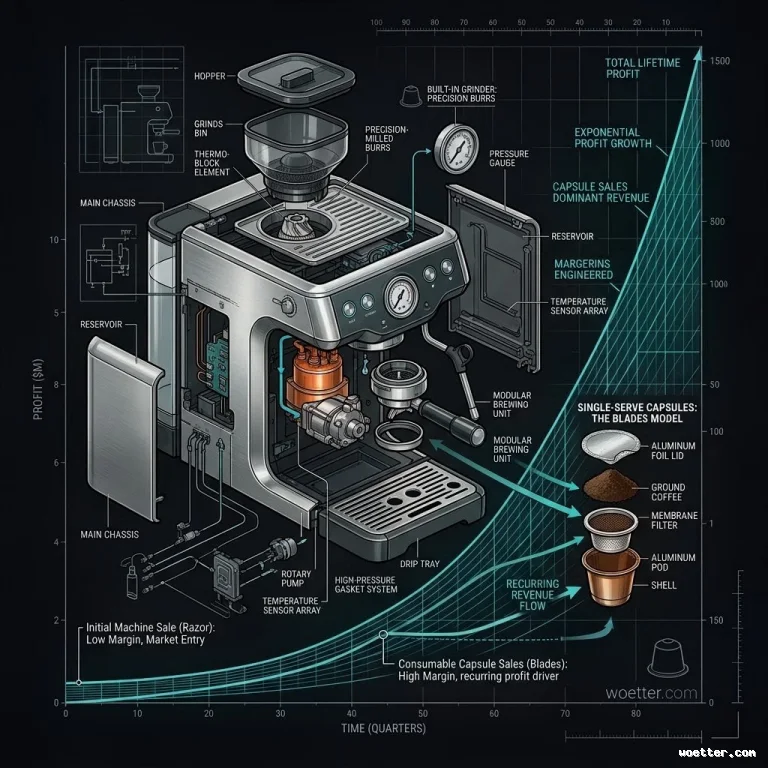
To comprehend Nespresso's financial miracle, one must regress to the classic Razor and Blades business model, popularized by Gillette. The structural premise of this business model dictates that the company sells the primary platform (the razor, the machine) at minimal margins or even a loss, to lock the consumer into a proprietary ecosystem of recurring consumables (the blades, the capsules) operating at astronomical margins.
However, Nespresso added a layer of psychological sophistication to this framework. They did not merely sell the cheap machine and the expensive capsule. They transmuted the product category.
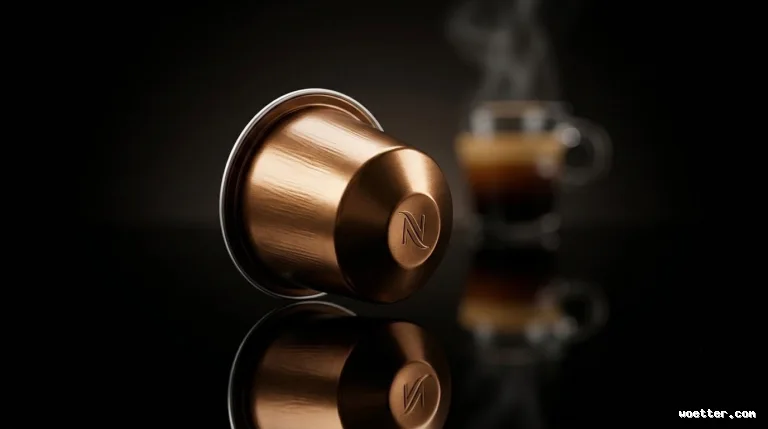
Anchoring Engineering and the Capsule
The central cognitive blockade to selling expensive coffee is the pre-existing price anchor in the consumer's mind. Over decades, supermarkets and retail chains have conditioned the public to associate a pound of coffee grounds with an average value of $10 to $15. If Nespresso attempted to sell a pound bag of premium coffee for $80, the cognitive friction would be insurmountable. The consumer would reject the offer outright.
The brilliance of the capsule is that it destroys the weight reference.
The capsule alters the unit economics in the client's perception. The consumer stops buying grams and starts buying "doses of experience." A standard Nespresso capsule contains approximately 5 grams of coffee and is sold for, say, $0.85.
By isolating the cost of the single dose, the consumer's brain performs a new price anchor.
They no longer compare the $0.85 of the capsule with the $15.00 of the pound of coffee at the grocery store. They compare the $0.85 of the capsule with the $4.50 they would pay for a similar espresso at a gourmet coffee shop in Manhattan or a high-end bistro in Paris. Nespresso anchored the capsule against the coffee shop experience, not against the grocery aisle.
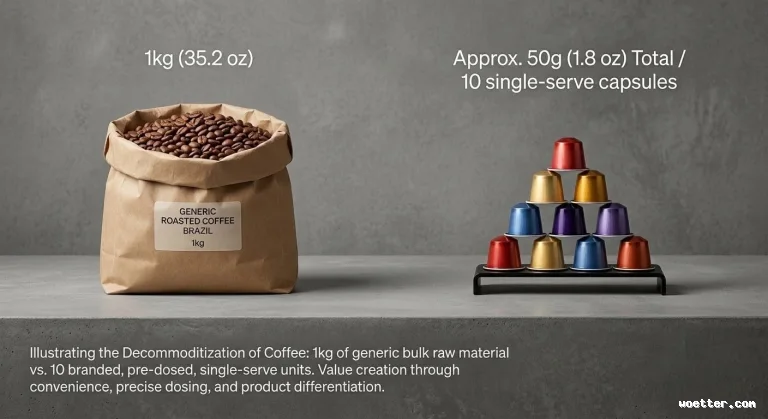
The Mathematics of Value Perception
In this new comparative metric, paying $0.85 for a high-quality espresso at home or in the office becomes an act of economy, not luxury. This is where the mathematical magic happens for Nestlé.
If a 5-gram capsule costs $0.85, elementary math reveals the true cost of the product: Nespresso is selling a kilogram of coffee (200 capsules) for a staggering $170.00.
They fragmented the commodity to obfuscate the real price. If the price were stamped on a brown paper bag ("$170 a kilo"), there would be no business. Encased in colored aluminum under an exclusive club lifestyle positioning (the Nespresso Club), the price becomes secondary to status and convenience.
Cost per Gram vs Cost per Experience
The imperative lesson for business strategists and Offer Architects is the malleability of marginal utility. When you alter the delivery format, you reset the pricing table in your client's brain.
SaaS companies and B2B service providers replicate this tactic constantly. Instead of selling a generic "management software" (heavily commoditized and anchored to low prices), they sell "automation credits" or "time-optimization licenses per user." They change the metric. They evade the unfavorable price anchoring and create a proprietary environment where they can dictate the absolute value without direct external comparisons.
Strategic Replication
To replicate the price anchoring strategy and the decommoditization business model within your own corporation, follow the three pillars of context shifting:
- Break the Standard Metric: If your market prices by the hour, price by the outcome. If the market prices by weight, price by the dose. Destroy the old benchmark.
- Build the Closed Platform: Create technical or operational dependency that demands the continuous and exclusive consumption of your high-margin inputs.
- Reposition the Comparative: Find the most expensive substitute possible for your new unit of measurement and anchor your price just below it.
Nespresso definitively proved that purely commoditized products do not exist, only unimaginative business models do. Value does not reside in the raw material, but in the architectural frame through which it is presented to the market.
Recommended Reading:
- Confessions of the Pricing Man, by Hermann Simon.
- The Strategy and Tactics of Pricing, by Thomas T. Nagle.
- Nudge: Improving Decisions About Health, Wealth, and Happiness, by Richard H. Thaler.
Is your company trapped in a commodity price war? Discover how to alter the unit of measurement of your offer and scale your margins without investing in product development. Subscribe to the newsletter and receive price anchoring strategies directly in your inbox.
