
The year is 1997. Apple Computer is hemorrhaging capital, rapidly losing market share to the Wintel (Windows and Intel) consortium, and operating just 90 days away from technical bankruptcy. The product line was a confusing labyrinth of dozens of Macintosh, Performa, and Quadra models. However, the most lethal symptom of the crisis lay not only on the shelves but in the institutional communication.
Pre-1997 Apple magazine ads were treated like engineering manuals. They were double-page spreads crammed with bullet points about megahertz, expansion ports, and motherboard specifications. The company was attempting to win the market war through a data war. It was precisely in this chaotic scenario that the Strategic Repositioning orchestrated by Steve Jobs and the TBWA\Chiat\Day agency intervened, applying, even if intuitively at the time, the most rigorous principles of behavioral economics and Communication Clarity.

The Paradox of Choice and Decision Fatigue
To analyze Apple's fatal flaw in 1996 and its brilliant correction in 1997, we must invoke the concept of the Paradox of Choice, later popularized by psychologist Barry Schwartz. The analytical premise is straightforward: although classical economic logic dictates that more information and more options benefit the consumer, human psychology proves the exact opposite.
When a consumer was exposed to nine-page Apple advertisements replete with IT jargon, their brain suffered processing overload, technically known as Cognitive Load. The caloric effort required to compare Macintosh model A with Macintosh model B, read technical specs, and make a decision was so high that the brain's default response was paralysis (analysis paralysis) or choosing the path of least resistance: buying a generic, beige, safe PC.
Complexity was actively murdering sales. The lack of Communication Clarity transformed the product, which was supposed to be a tool for creative liberation, into an arduous task.
The Cognitive Guillotine: The Birth of "Think Different"
Upon regaining control, leadership's first and most aggressive move was not to invent a new chip, but to decimate the confusion. The Strategic Repositioning required a brutal simplification, both of the product line (reduced to a 2x2 matrix: Desktop/Portable, Professional/Consumer) and, critically, of the message.
The Cognitive Reduction applied to the "Think Different" campaign stands as the greatest branding case of the 20th century because it completely removed the product from the initial equation.
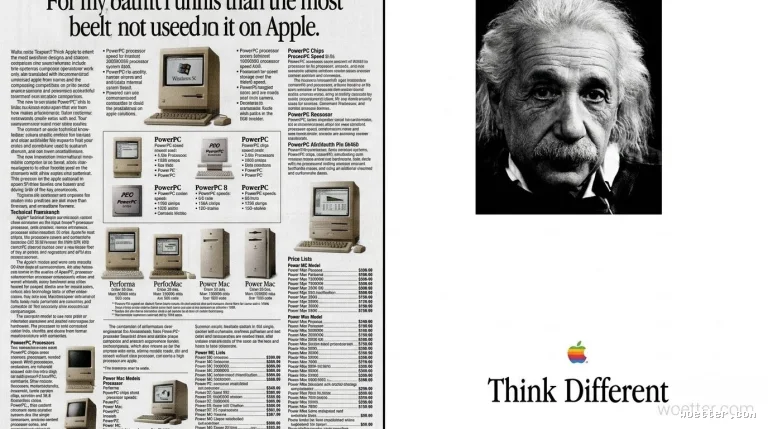
Where there were once comparative processor tables, there was now the face of Albert Einstein, Muhammad Ali, or Pablo Picasso, accompanied by a single sentence. No computer image. No specifications. No mention of speed or price.
The Psychological Engineering Behind Simplification
Why did a campaign with zero product information generate absurd sales leverage and save the company? The success rests upon three pillars of applied human behavior:
- Cognitive Fluency: Messages that are easy to process are subconsciously judged as truer, more beautiful, and more trustworthy. "Think Different" demands zero technical translation effort. The phrase immediately anchors itself in the consumer's aspirational identity.
- Identity Over Utility: As argued in the previous essay regarding the Luke Skywalker Error, clients do not buy products; they buy better versions of themselves. By stopping the talk about motherboards and starting the talk about "the ones who are crazy enough to think they can change the world," Apple activated the In-group Bias. Buying a Mac became a declaration of creative identity, not a hardware decision.
- Asymmetrical Noise Reduction: Cognitive Reduction is not merely speaking less; it is removing the background noise so that the central signal (the core value) becomes deafening. By silencing the technical specs, Apple allowed the perceived value of the brand to echo.
The Practical Application for Today's Corporations
The 1997 Apple case is not a fairy tale about pretty advertising; it is a high-precision operations manual on consumer attention allocation. Today, executives commit the same 1996 Apple mistake in their B2B presentations (Pitch Decks), on their sales pages, and in their pricing models (complex SaaS pricing tiers).
The architectural rule for high performance is this: if you need a paragraph to explain why your product is better, you have already lost the sale.
Auditing Communication Clarity and Strategic Repositioning requires ruthlessly cutting jargon, reducing offered options, and isolating the transformational benefit in its purest form. Complexity is a shield that insecure companies use to justify prices. Simplicity is the weapon of brands that dominate their markets.
Is your company publishing nine pages of features, or leading with a single, undeniable truth?
Recommended Reading
- The Choice Architecture in B2B Pricing
- Survivorship Bias in Competitor Analysis
- The Hidden Cost of Friction in UI
Does your corporate communication need a guillotine or a microscope? Subscribe to the newsletter to gain weekly access to the most dense and applicable analyses on behavioral economics, brand strategy, and high-performance execution.
