
The Invisible Architecture of Revenue Loss
In the contemporary corporate ecosystem, the battle for consumer attention and capital is not won by the entity possessing the superior product, but by the one demanding the least amount of effort. Behavioral economics teaches us that human beings are inherently energy optimizers. When an organization introduces unnecessary barriers into its purchasing journey, it is levying what we call a Friction Cost. This is an invisible tax, paid in cognitive capital, that inevitably destroys User Experience and annihilates Sales Conversion.
To comprehend the gravity of Friction Cost, it is imperative to abandon the classical view of economics, which assumes that consumers are perfectly rational agents (Homo economicus). The reality, extensively documented by academics such as Daniel Kahneman, is that the human brain operates in two systems. System 1 is fast, instinctive, and emotional. System 2 is slow, deliberative, and highly energy-consuming. Friction forces the customer to activate System 2. Every additional click, every complex form, every obscure return policy is a drain on this finite reserve of energy.
The Anatomy of Cognitive Friction
Cognitive friction occurs when a business interface—whether digital or physical—fails to align with the user's preexisting mental models. This generates Cognitive Load. When the Cognitive Load exceeds the user's motivation to complete the task, abandonment occurs.
The central rule of modern business architecture is ruthless: the reduction of Friction Cost is the most underestimated shortcut to the exponential increase of Lifetime Value (LTV).
There are three primary dimensions of friction that erode Sales Conversion:
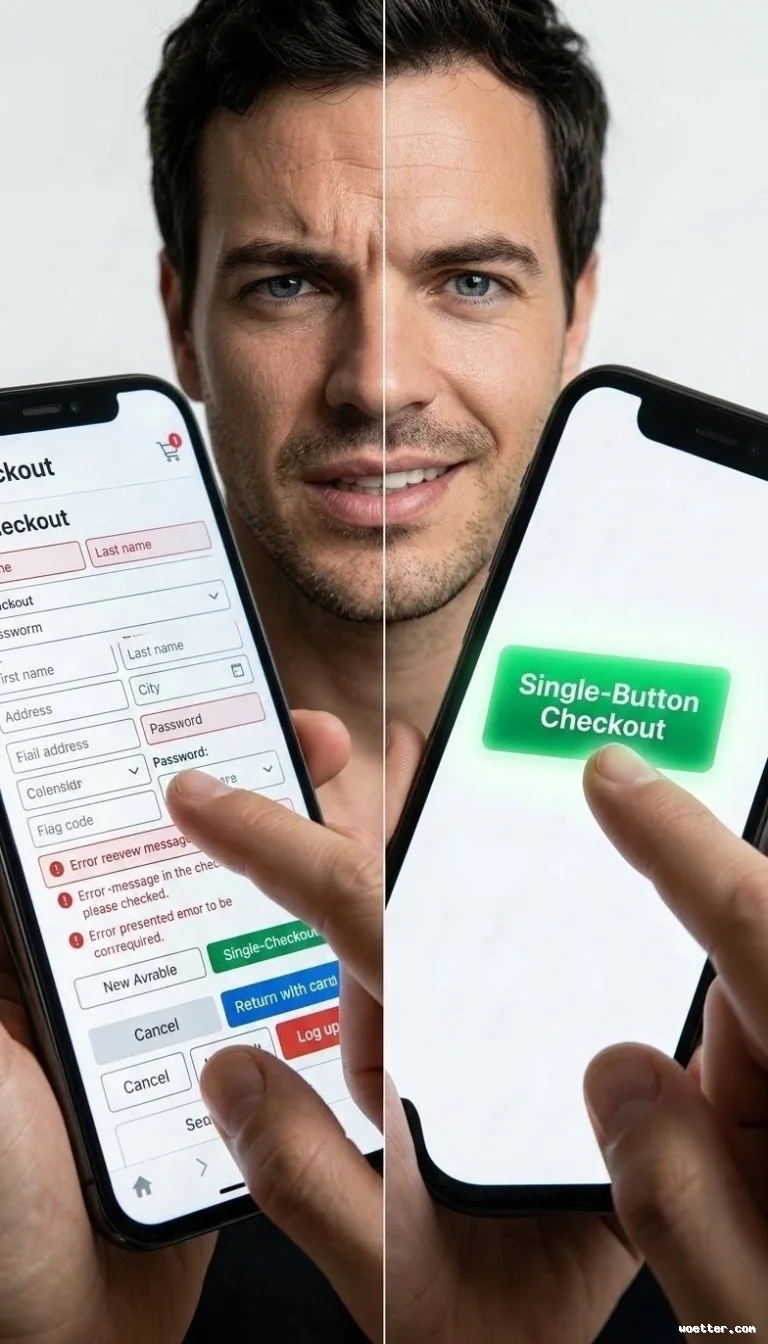
- Interactional Friction: The mechanical difficulty of executing an action. Example: websites that are not mobile-optimized or checkout processes that mandate account creation.
- Cognitive Friction: The mental confusion caused by ambiguous information, unnecessary jargon, or an excess of options (the Paradox of Choice).
- Emotional Friction: The anxiety generated by a lack of transparency, such as hidden shipping costs revealed only at the final step of the purchase, triggering the Loss Aversion bias.
The Compounding Effect of Frictionless Design
The elimination of friction does not produce linear results; it produces exponential results. When Amazon patented "1-Click" purchasing in 1999, they were not merely improving User Experience; they were constructing an insurmountable Economic Moat. They understood that the time between purchase intent and transaction completion is the breeding ground for objections.
By reducing time and effort to near zero, you neutralize the consumer's ability to reconsider. System 1 dominates the action. The purchase becomes fluid, almost imperceptible. This is the apex of behavioral engineering applied to business. Friction Cost is converted into Equity.
Conversely, companies that ignore this metric suffer from a silent hemorrhage. Executives analyze Customer Acquisition Cost (CAC) spreadsheets and blame the marketing team for poor performance, when the true bottleneck lies in the product's architecture. The customer was acquired, the desire was instilled, but operational friction murdered the transaction.
The Geographic and Strategic Impact Block
In highly competitive and dense markets like global financial hubs, where the pace of life demands absolute efficiency, companies that ignore Friction Cost are signing their own obsolescence. The metropolitan consumer has zero tolerance for inefficient processes. User Experience ceases to be an aesthetic differentiator and becomes the very core of the value proposition. Local commercial operations that map and eradicate friction points in their funnels invariably capture the Market Share of slower, bureaucratic competitors.
Positive Friction: When Resistance is Strategic
It is fundamental, however, to separate dogma from strategy. Not all friction is harmful. There is the concept of Positive Friction. In scenarios of high complexity or financial risk, adding deliberate steps can increase user trust.
For instance, in high-value wire transfers or the deletion of accounts and critical data, an additional confirmation step (such as entering a password or two-factor authentication) prevents catastrophic errors and conveys institutional security. The genius of the Business Architect lies in knowing exactly where to lubricate the machinery and where to apply tactical brakes.
The definitive metric is not the total absence of friction, but the absence of unwanted friction. If your business model requires the customer to jump through hoops to hand you money, you are not operating a business, you are managing an obstacle course. And in the high-performance market, consumer patience always runs out before the finish line.

Recommended Reading
"Nudge: Improving Decisions About Health, Wealth, and Happiness" by Richard H. Thaler and Cass R. Sunstein. A foundational work to understand choice architecture and how small alterations in the environment can drastically influence human behavior and economic decisions.
Your operation is bleeding revenue right now due to lengthy forms, excessive clicks, and cognitive confusion. Do not leave your profit margin on the table. Subscribe to our newsletter to receive elite strategies to audit and optimize your business architecture.