The Main Product Illusion and the Hidden Business Model
In the rigorous study of corporate architecture and strategy formulation, we rarely analyze the entertainment industry and the arts with the technical gravity they rightfully demand. However, few global corporate entities have mastered the advanced concept of brand monetization quite like the British heavy metal institution, Iron Maiden.
The vast majority of amateur observers and market journalists focus exclusively on the music—naively believing that this is the core product and the primary profit engine of the operation. Elite strategists, conversely, ignore the superficial noise and examine the formidable logistical engineering and the cash flow structure operating relentlessly behind the scenes.
The central thesis of this operation is the Decoupling Strategy. Iron Maiden's management board recognized, decades before the terminal crisis of the recording industry caused by the advent of MP3s, digital piracy, and the streaming economy, that relying financially and exclusively on physical record sales was a structurally fragile business model.
For them, recorded music was not the commercial endgame; music functioned perfectly as the Customer Acquisition Cost (CAC)—a massive, high-impact marketing vehicle with global reach, specifically designed to construct a fanatically loyal fan base. Once this base was acquired, the objective was to extract substantial value through an incredibly lucrative ancillary ecosystem: controlled live touring and, primarily, the monstrous scale of merchandise sales.

Behavioral Economics and Corporate Tribalism
To truly comprehend the lethal efficiency of the Iron Maiden strategy, it is strictly imperative to examine the phenomenon through the lens of behavioral economics. The cognitive engine propelling this invisible financial empire is the surgical exploitation of Tribalism coupled with the deep-seated bias of In-Group Favoritism.
Human beings are not purely rational consumption agents; we possess a deeply rooted evolutionary necessity to belong to groups that display clear visual identities, moral codes, and ideological markers. Iron Maiden never merely sold heavy metal albums; they architected a hermetic identity, impermeable to external market trends.
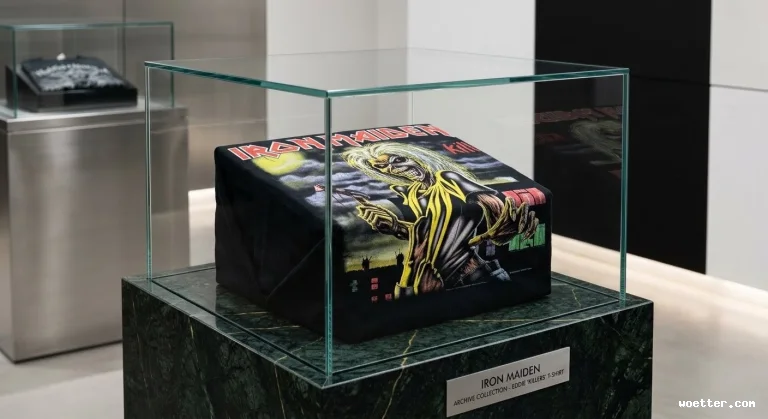
The brilliant creation of their mascot, Eddie, the skeletal being that brands every single product of the band with infinite variations, is not just an illustration. It served—and still serves—as the definitive logo of a vast corporate tribe.
When a consumer wears the iconic black t-shirt, they are not simply acquiring a piece of cotton that cost a few dollars to produce; they are actively purchasing Status within their specific social niche and clearly signaling their belonging to that tribe. As a behavioral result, the consumer's Willingness to Pay curve shifts upward exponentially, as the product transcends its basic physical utility and converts into a non-negotiable marker of personal identity. This is the absolute pinnacle of Brand Equity construction that money can buy.
The Inflexible Identity Rule: Corporate brands that dilute their core message in a desperate attempt to appease the general masses inevitably lose their pricing power. Brands that polarize the market, reject non-believers, and aggressively embrace extreme niches create true emotional monopolies immune to price competition.
Logistical Engineering and Global Operational Scale
The brilliant execution of the Iron Maiden strategy is not confined to the domains of mass psychology; it represents an absolute triumph in complex logistical operations. Let us analyze the granular structure of this model.
By orchestrating massive stadium world tours—going to the logistical extreme of piloting their own modified Boeing 747, dubbed Ed Force One, to nullify transport friction, optimize routing, and mitigate the exorbitant international freight costs of heavy equipment—the band acts, in practice, as a sophisticated, unprecedented B2C distribution machine within the sector.
- The Physical Distribution Monopoly: Unlike traditional record labels that cannibalized the overwhelming majority of profit margins on retail CD sales, the Profit Margin on the direct-to-consumer sale of t-shirts, hoodies, and accessories inside concert arenas is colossal. This margin is almost entirely controlled, retained, and reinvested by the band's own management entity.
- Engineered Scarcity and Transactional Urgency: The sale of event-specific, exclusive merchandise perfectly executes the psychological triggers of Scarcity and FOMO (Fear Of Missing Out). The commemorative tour t-shirt for a specific city will only be available at that venue, and only on that exact night. This annihilates the consumer's cognitive inertia and forces an irrational, immediate purchasing decision, completely ignoring the inflated price point.
- Continuous Ecosystem Monetization: The institution did not stop at apparel. They aggressively expanded their brand monetization vectors into high-margin licensing, creating multi-million dollar craft beer brands (such as Trooper Ale), video games, and action figures, effectively transforming fans who attended shows once a year into continuous consumers of a comprehensive lifestyle ecosystem.
The Definitive Lesson for Modern Executives
What must a tech sector CEO, an industrial director of heavy machinery, or the founder of a B2B SaaS absorb, practically speaking, from this unorthodox case study?
Understand that your shelf-ready product often needs to act merely as the primary vehicle for acquiring attention in a saturated market. True, scalable elite corporate value resides in your institutional capability to construct a captive audience and monetize the prolonged relationship with that base, intelligently diversifying ancillary revenue vectors without ever corrupting the corporation's core identity.
If your current business model relies dangerously on a single product line, characterized by a low technical barrier to entry and a total absence of emotional retention, your enterprise is naked and vulnerable to imminent commoditization. Build a rigid identity. Define your common enemy. Create the corporate equivalent of your own symbolic mascot. Transform transactional, passive clients into an impenetrable, defensive tribe.
Operating in hyper-competitive financial and industrial environments globally, we observe daily how the dynamics of complex markets crush companies with generic corporate identities. The capability to forge a robust product ecosystem around a solidified brand is exactly what separates commodity operators from the elite corporations that dictate market rules and attract smart capital.
Recommended Reading
A profound understanding of identity-based monetization requires rigorous grounding in behavioral economics. We mandate the study of Tribes by Seth Godin to master the mechanics of In-Group Favoritism and the leadership of extreme niches. Complement this with Primalbranding by Patrick Hanlon, the technical dissection of how cult brands architect their cultural codes, rituals, and ecosystems of inflexible loyalty.
Does the architecture of your brand strategy generate price-sensitive transactional buyers, or does it methodically construct an ecosystem of extreme loyalty absolutely immune to market fluctuations and crises? Understanding the deep psychology behind retention is a fiduciary duty. Subscribe to our newsletter to receive advanced corporate dissections and business architecture frameworks engineered strictly for the executive elite.