
The transition from theory to execution is the graveyard of great corporate strategies. In our previous essay, we established that high-performance companies must abandon the illusion of stability and embrace Antifragility. The architectural challenge that follows is clear: how does an organization systematically inject chaos into its operations without committing corporate suicide?
The definitive answer to this dilemma did not come from Wall Street or traditional consultancies, but from Silicon Valley, more specifically, from Netflix. The creation of the Chaos Engineering concept and the Chaos Monkey tool revolutionized how tech companies handle risk, transforming a vector of vulnerability into an unassailable competitive advantage.
The Cloud Infrastructure Dilemma
To understand the magnitude of the solution, one must analyze the landscape. In 2008, Netflix suffered a massive database outage that halted the shipment of DVDs (their core business at the time) for three days. That catastrophic event was the inflection point. Leadership concluded that relying on monolithic physical infrastructures and relational databases was inherently fragile. The executive decision was to migrate the entire operation to the public cloud (Cloud Computing) of Amazon Web Services (AWS).
However, the cloud presents a new type of risk. You outsource the hardware, but you also inherit the provider's instabilities. Virtual server instances on AWS can fail, disappear, and reboot without warning. Netflix was trading a localized, predictable fragility for a global, unpredictable complexity.
Instead of trying to build a perfect, failure-free system on top of an ephemeral infrastructure — a mathematical impossibility — Netflix engineers changed the behavioral matrix of the problem. They assumed that failure was not only inevitable but constant.

The Birth of the Chaos Monkey
The thesis was brilliant: the only way to be absolutely certain that your system can survive an unexpected server crash on a Friday night is by intentionally shutting that server down on a Tuesday morning, while all engineers are in the office, coffee in hand, ready to act.
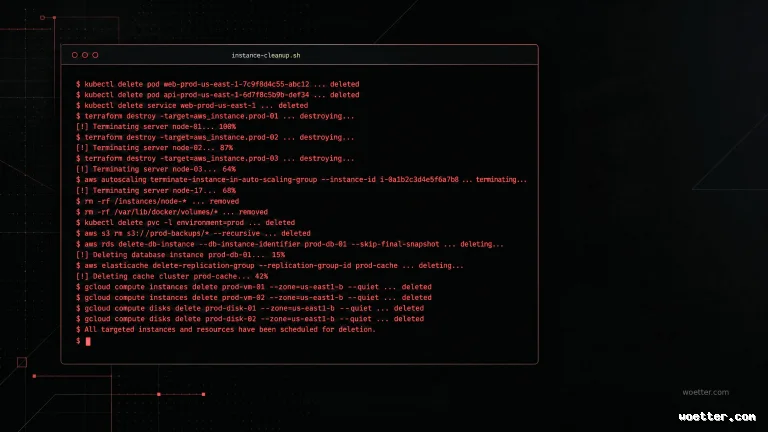
Thus, the Chaos Monkey was born. It is internally developed software whose sole purpose was to wreak havoc. The Chaos Monkey was programmed to roam Netflix's infrastructure during business hours and randomly terminate production instances.

Destruction was automated. By forcing continuous failures in the actual live environment where users watch movies, Netflix compelled its engineers to build services that were resilient by default. If a developer wrote code that could not handle the abrupt shutdown of a server, the Chaos Monkey would expose it in days, not months. Downtime ceased to be an emergency crisis and became a routine metric.
The Expansion to the Simian Army and Organizational Culture
The success of micro-scale volatility injection was so overwhelming that Netflix's business architecture scaled Chaos Engineering to the macro level. The Chaos Monkey evolved into a suite of tools dubbed the Simian Army.
- Chaos Kong: While the Monkey shut down individual servers, Chaos Kong was designed to simulate the apocalypse: dropping an entire AWS region (a complete data center).
- Latency Monkey: It injected artificial slowness into the network to test how systems handled severe degradation, ensuring that the failure of one service would not cause a domino effect bringing down the entire application.
Failure Injection as an Organizational Culture
The true genius of the Chaos Monkey is not technical; it is cultural and economic. By institutionalizing Chaos Engineering, Netflix leadership hacked the behavioral economics of their own employees.
Usually, software engineers skip rigorous resilience testing due to deadline pressures. But when programmers know, as an inexorable fact, that their system will be attacked and potentially shut down by an internal robot within the next few days, they program with Antifragility in mind from line one of the code. Anticipated stress guarantees flawless execution.
Leadership Lessons from Controlled Chaos
The application of this Case Study transcends IT. The principle of Chaos Engineering must be applied to the entire value chain. As a business architect, you must build the "Chaos Monkeys" for your finance department, your logistics, and your sales team.
What happens to your sales operation if your best acquisition channel is randomly "turned off" for a day? What happens to cash flow if a major client deliberately delays payment in an internal simulation?
Designing fail-proof systems is corporate arrogance that invariably results in collapse. High performance requires that you stop trying to prevent the fire and start testing the fire extinguishers while the building is still under control.
Recommended Reading:
- Chaos Engineering: System Resiliency in Practice by Casey Rosenthal and Nora Jones.
Chaos Engineering is just the beginning of antifragile architecture. To receive in-depth analysis on how to structure high-performance companies, subscribe to our executive newsletter.