
The Architecture of Attention: A Strategic Essay on Positioning and Content Tilt
In the digital corporate world, the opposite of love is not hate. It is indifference. The harsh market reality is that 95% of the content produced by companies and experts today is commercially useless. Not because the information is technically wrong, but because it is rigorously identical to everything else. If your blog, your LinkedIn, or your company's Instagram disappeared from the internet tomorrow morning, would your client miss it? If the answer is "no," you don't have a traffic problem; you have a positioning problem. Joe Pulizzi, founder of the Content Marketing Institute, cracked the code to escape this trap. It is not about producing higher volumes. It is about finding two strategic vectors: the sweet spot and the content tilt.

The Strategic Foundation: The Sweet Spot
Many marketing "gurus" advise: "Talk about what you love." Others, more pragmatic, dictate: "Talk about what makes money." Both premises are incomplete and dangerous in isolation.
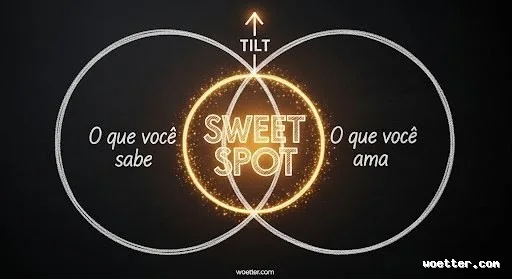
The sweet spot is the exact intersection of a Venn diagram. It requires the crossing of two non-negotiable forces:
Knowledge (Competence): Where does your real technical authority reside? What can you do, analyze, or teach better than the market average?
Passion: What topic would you read about obsessively on a Saturday night, for free, without anyone asking?
If you possess competence but lack passion, your content turns into a refrigerator manual—dry, monotonous, and incapable of generating retention. If you have passion but lack competence, your content is a teenage diary—useless for solving corporate problems. You absolutely need both to form your sweet spot. However, behavioral economics teaches us that just being competent and passionate does not guarantee attention in a saturated market. That is merely the beginning.
The Quantum Leap: The Engineering of Content Tilt
Having a defined sweet spot does not guarantee a profitable audience. Practical example: you are a professional Chef and you love cooking (this is your Sweet Spot). Excellent! The problem is that there are 10 million other cooking channels on YouTube. If you create "just another recipe channel," you will be ignored by the sheer inertia of the market.
To overcome the barrier of indifference, you need the content tilt. The concept refers to tilting your perspective to observe the same reality from an angle no competitor is exploring. It is the creation of a Blue Ocean within your niche.
The Ann Reardon Case Study: Ann was a food scientist passionate about baking. Instead of launching "just another generic cake blog" (where she would be crushed by the competition), she applied the content tilt.
Without Tilt: "Delicious cake recipes."
With Tilt: "Food science applied to debunk viral fake TikTok recipes and create physically impossible cakes."
The result? Millions of followers and unquestionable authority. She didn't try to compete with traditional culinary giants; she used the content tilt to create a monopolistic category where she was the only option.
The Content Mission (The CEO Filter)
To keep your content tilt sharp and avoid getting lost producing useless material, your company needs a "Content Mission Statement." Unlike those egocentric corporate missions pasted on the reception wall ("To be the biggest company in the sector"), the content mission focuses exclusively on the consumer's transformation.
The structural formula is brutally simple: [Help WHO] + [Do WHAT] + [To achieve what RESULT]
The Wrong Model (Commodity): "Technology and innovation tips."
The Strategic Model (Mission): "Help mid-sized IT managers to better lead their remote teams to get promoted to directors in 12 months."
Before spending a single dime boosting a post or writing an article, submit it to your mission filter. If the content doesn't help the IT manager get promoted, delete it.
📚 Recommended Reading
To master the creation of fanatical audiences and the structuring of profitable editorial lines:
"Content Inc." - Joe Pulizzi: The definitive book introducing the concepts of the sweet spot and content tilt to build million-dollar businesses based on audience-first models.
"Blue Ocean Strategy" - W. Chan Kim and Renée Mauborgne: The theoretical basis on how to make competition irrelevant by changing market boundaries.
Strategic Conclusion
The modern marketing strategist understands the "Box Test." If someone took all the content your company produced over the last year, put it in a box, and hid it... would your clients notice? Would they send furious emails asking where you went? If your content is just a technical commodity without a clear content tilt, the answer is no. They would simply move on to the next competitor in their feed. Survival in the era of information superabundance requires that you stop trying to be "better" and start focusing on being "different." Find your angle. Tilt your communication. Be the only possible source of intellectual survival for your client.
Are you spending hours producing content that doesn't generate contracts? Subscribe to the newsletter in the field below, download our "Content Mission Canvas," and discover how to apply Content Tilt to transform your company into an authority impossible to ignore.
