Woetter.com
UX Friction: The Unintentional Grind That Invisibly Destroys Your Sales
UX Friction and cognitive load are the invisible killers of your sales. Discover how unintentional friction sabotages revenue and learn the exact architecture to eliminate conversion obstacles.
- UX Friction and cognitive load are the invisible killers of your sales.
- Discover how unintentional friction sabotages revenue and learn the exact architecture to eliminate conversion obstacles.
Modern conversion architecture suffers from a silent pathology. Executives and marketing directors allocate budgets in the millions toward traffic acquisition campaigns, bid algorithm optimization, and brand narrative construction. However, when this hard-won and highly expensive traffic finally lands on their digital properties, it is summarily decimated by an invisible assassin. This killer is not a lower-priced competitor. It is not a sudden technological disruption. It is something much more prosaic and infinitely more lethal: UX Friction.
UX Friction is any element within an interface, user journey, or business process that adds unnecessary resistance, hesitation, or mental effort to the execution of an action. In behavioral economics, we understand that humans are, by evolutionary design, cognitive misers. When your interface forces a user's brain to process irrelevant information, decipher illogical flows, or input data that offers no immediate benefit to the transaction, you are activating System 2 – the analytical, slow, and high-energy-consuming mode of thought outlined by Daniel Kahneman. The result? What we term Ego Depletion. The user abandons the process not because the product is subpar, but because buying from you is exhausting.
The Economic Anatomy of UX Friction
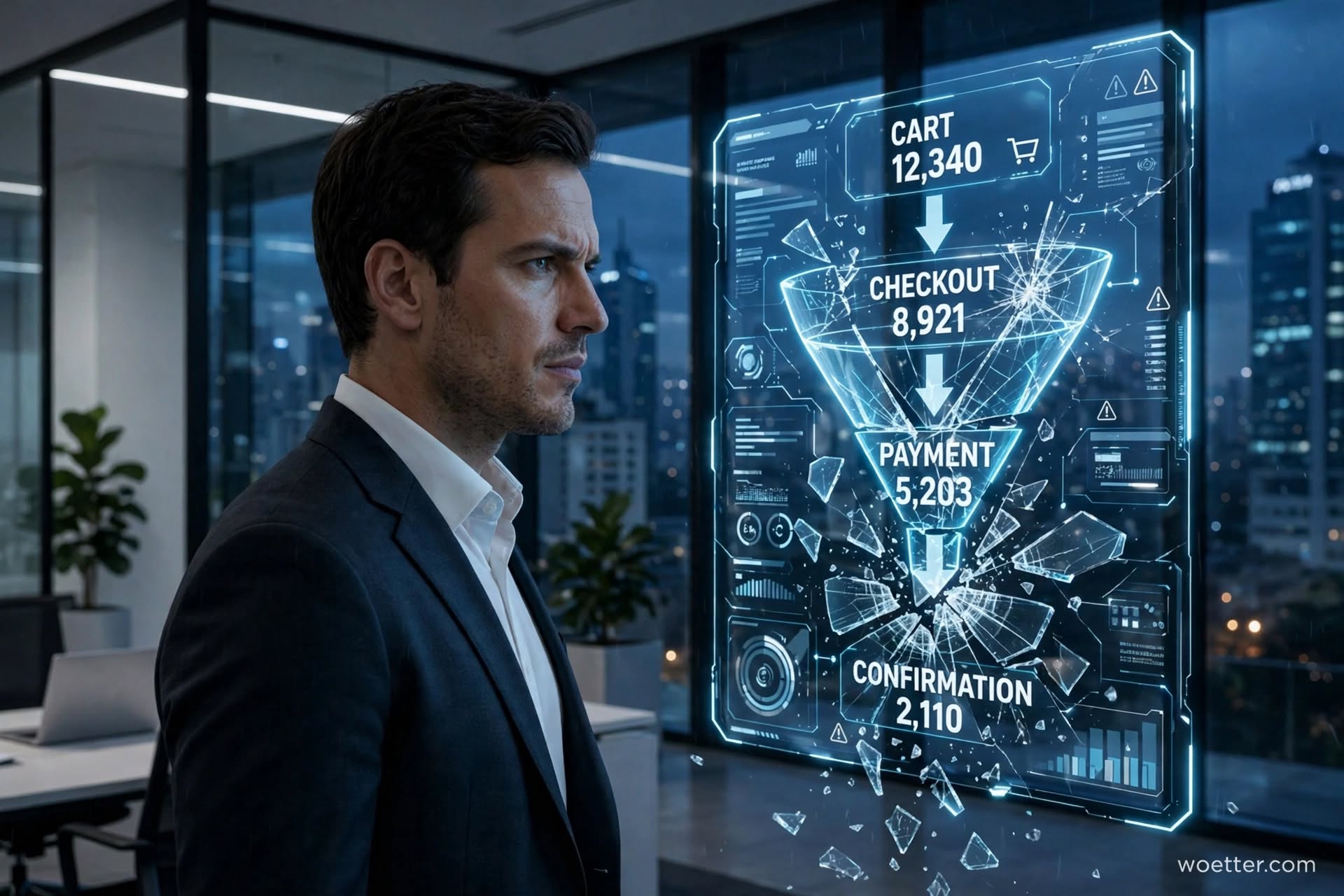
To grasp the gravity of UX Friction, we must abandon the notion that "usability" is merely a qualitative metric belonging to the design department. UX Friction is a quantitative financial metric.
Imagine an e-commerce funnel generating $10 million annually with a 2% conversion rate. If a confusing checkout form, slow loading times, or a low-contrast call-to-action button causes hesitation that drops that conversion to 1.8%, the company has just lost $1 million in annual gross revenue. UX Friction does not diminish the intent to purchase; it punishes the execution of the purchase. It acts as a tax on your company's revenue – a tax you enacted yourself and are paying to yourself, only to set the money on fire.
Cognitive Load and Hick's Law
The psychological bedrock of UX Friction lies in Cognitive Load Theory. Human working memory possesses a strictly limited capacity for processing new information. When we present a digital interface to a user, we impose three types of cognitive load:
- Intrinsic Load: The effort inherent to the complexity of the task itself (e.g., understanding mortgage interest rates). This cannot be eliminated, only managed.
- Germane Load: The effort invested in building mental schemas to learn something useful. This is positive processing.
- Extraneous Load: Pure UX Friction. This is the mental effort wasted trying to understand how your poorly designed interface works. Searching for the checkout button. Trying to figure out why the form is returning a generic error. Deciphering a navigation menu with 40 categories.
The strategic imperative of any digital business is to reduce Extraneous Load to absolute zero.
This leads directly to Hick's Law, a fundamental behavioral psychology principle stating: the time it takes for a person to make a decision is logarithmically proportional to the number of available choices. In business practice, with every new irrelevant option you add to a screen, every unnecessary banner, and every extra form field, UX Friction increases, paralyzing the user in what we call Choice Overload.
The Three Dimensions of Unintentional Friction
UX Friction does not only manifest in long forms. It hides in the systemic complexity of your digital operations. We can categorize it into three primary dimensions.
1. Interaction Friction (The Motor Cost)
This is UX Friction in its most physical form. It involves the number of clicks, the need for excessive scrolling, switching between keyboard and mouse, or trying to tap targets that are too small on mobile screens.
The Golden Rule of Interaction: Every additional click required in a conversion funnel will statistically reduce the number of users who reach the end. Amazon understood this masterfully with the "1-Click Buy" patent, essentially eliminating all motor friction from the purchasing process after the first transaction.
2. Visual Friction (The Aesthetic Noise)
This occurs when the layout is dense, chaotic, or lacks a clear visual hierarchy. The user's eyes must scan the entire screen, expending energy to find the primary focus. Clashing colors, lack of white space, and illegible typography create a subconscious barrier. The brain interprets visual chaos as systemic disorganization, triggering risk aversion mechanisms. If your site looks untrustworthy due to visual UX Friction, the user will not input their credit card data.
3. Cognitive Friction (The Mental Maze)
The most insidious form of UX Friction. It happens when the interface requires the user to decipher your business mental model rather than the system adapting to the user's mental model. Unexplained corporate jargon. Product categories that only make sense to your engineering team. Checkout processes that demand account creation before even displaying shipping costs.
Executive Methodology for Eradicating UX Friction

For business leaders, the removal of UX Friction should not be an isolated project, but a continuous culture of Conversion Rate Optimization (CRO). Implementation requires a surgical approach.
Step 1: Critical Path Mapping. Define the page's single metric of success (The North Star Metric). Is it the sale? The lead? Identify the exact path the user must traverse to complete this action. Anything that does not actively serve this path is noise and generates UX Friction.
Step 2: Interruption Auditing. Utilize heat maps and session recordings to identify where the mouse cursor hesitates or the flow stops. At these exact points, UX Friction is present. Ask: What is impeding the cognitive flow here?
Step 3: The Strategy of Subtraction. The common mistake in optimization is adding elements to explain difficult things. True brilliance lies in subtraction. If a form requires a tutorial, the form is wrong. Remove fields, clear sidebars, shrink text. UX Friction dies in intentional minimalism.
Step 4: Anxiety Anticipation Microcopy. UX Friction often arises from fear. A user hesitates to provide their phone number out of fear of spam. Eliminate this UX Friction by injecting microcopy next to the field: "For delivery updates only. No spam." You have just reduced the cognitive load of risk assessment.
The highest-cap companies in the world, operating in the fiercely competitive global tech environment, do not base their success solely on product innovation. They base their dominance on the relentless removal of UX Friction. They understand that in the digital market, fluidity is a competitive advantage as valuable as pricing. The true competitive edge of companies in major financial hubs like Wall Street or Silicon Valley isn't just in the complexity of their algorithms, but in the ability to translate that complexity into an interface so frictionless that the transaction feels inevitable.
If you intend to protect and maximize the Return on Investment (ROI) of every visitor your brand attracts, the corporate mandate is clear: declare total war on UX Friction. Do not expect your customer to climb the mountain of your sales process; instead, level the ground beneath their feet.
Recommended Reading
- Don't Make Me Think by Steve Krug: The fundamental, unquestionable bible on usability. The title itself is the ultimate definition of eliminating Cognitive Load.
- Thinking, Fast and Slow by Daniel Kahneman: Essential for understanding Systems 1 and 2, the neurobiological basis for why UX Friction destroys sales.
- Friction by Roger Dooley: How the elimination of friction became the most powerful competitive advantage in modern business.
Are you ready to audit your conversion processes and identify where hesitation is eroding your profitability? Subscribe to our newsletter to receive advanced strategies in business architecture and behavioral economics, applied directly to corporate high performance.
If you want to master behavioral economics and modern business architecture to protect your organization, subscribe to our newsletter. Pure strategy, zero noise.