Woetter.com
The Hero's Mistake: Why Egocentric Brands Lose Market Share and How to Assume the Guide Archetype
Discover how the egocentric bias destroys brands and why assuming the role of the guide for your customer is the only sustainable strategy to scale.
- Discover how the egocentric bias destroys brands and why assuming the role of the guide for your customer is the only sustainable strategy to scale.
- Actionable governance and commercial leverage for B2B organizations.
- Frameworks engineered by Eduardo Wöetter based on executive case studies.
In the contemporary business environment, the battle for consumer attention is not won by whoever shouts the loudest, but by whoever understands the hidden gears of human cognition. We have entered an era where a company's positioning architecture determines its survival. However, there is a systematic flaw that permeates boardrooms, advertising agencies, and marketing departments across the globe. We will call this anomaly The Hero's Mistake. It is a corporate manifestation of the Egocentric Bias, where the brand, intoxicated by its own founding story, its product specifications, or the awards it has accumulated, decides to position itself as the protagonist of the commercial narrative. This essay will deconstruct why this approach destroys brand value and how the rigorous adoption of the guide archetype can reverse market stagnation.
The Illusion of Corporate Protagonism
The human brain is a survival and caloric optimization machine. It incessantly scans the environment for information that helps it prosper, save energy, and ascend in the social hierarchy. When a company presents itself as the hero, it directly collides with the consumer's biological programming. The customer is not looking for another hero; they are already the hero of their own story. When two entities try to occupy the protagonist's space, cognitive friction occurs. The consumer's brain rejects the competing message, classifying it as noise.
Neuroscience applied to marketing shows us that the Narrative Fallacy dictates how we interpret complex events, forcing them into logical and causal patterns. We understand the world through stories. In every classic story, the hero begins with a problem, meets a competent guide, receives a plan, and is called to action to avoid failure and achieve success. The Hero's Mistake occurs when the brand says: 'Look at us, look at our size, look at our revolutionary technology, we will save your day'. The customer, faced with this discourse, feels no relief. They feel competition. They do not want to be saved by a knight in shining armor; they want to be handed the magical sword so they can defeat the dragon themselves.
The Cost of Complexity and Cognitive Load
Egocentric brands often compensate for their lack of empathy with an excess of information. They dump technical jargon, complex organizational charts, and irrelevant corporate histories on the homepages of their websites and in their pitch decks. This drastically elevates the cognitive load demanded of the prospect. In behavioral economics, we know that human beings have an inherent preference for Cognitive Ease. If understanding the offer requires too much mental effort, the brain resorts to the heuristic of rejection.
The fundamental rule of positioning is: if you confuse, you lose. If a visitor cannot answer in five seconds what you offer, how it improves their life, and what they need to do to buy, they will abandon your platform. Positioning as a hero is inherently confusing because it forces the customer to translate your company's glories into tangible benefits for their own life.
The Strategic Transition: From Protagonist to Mentor
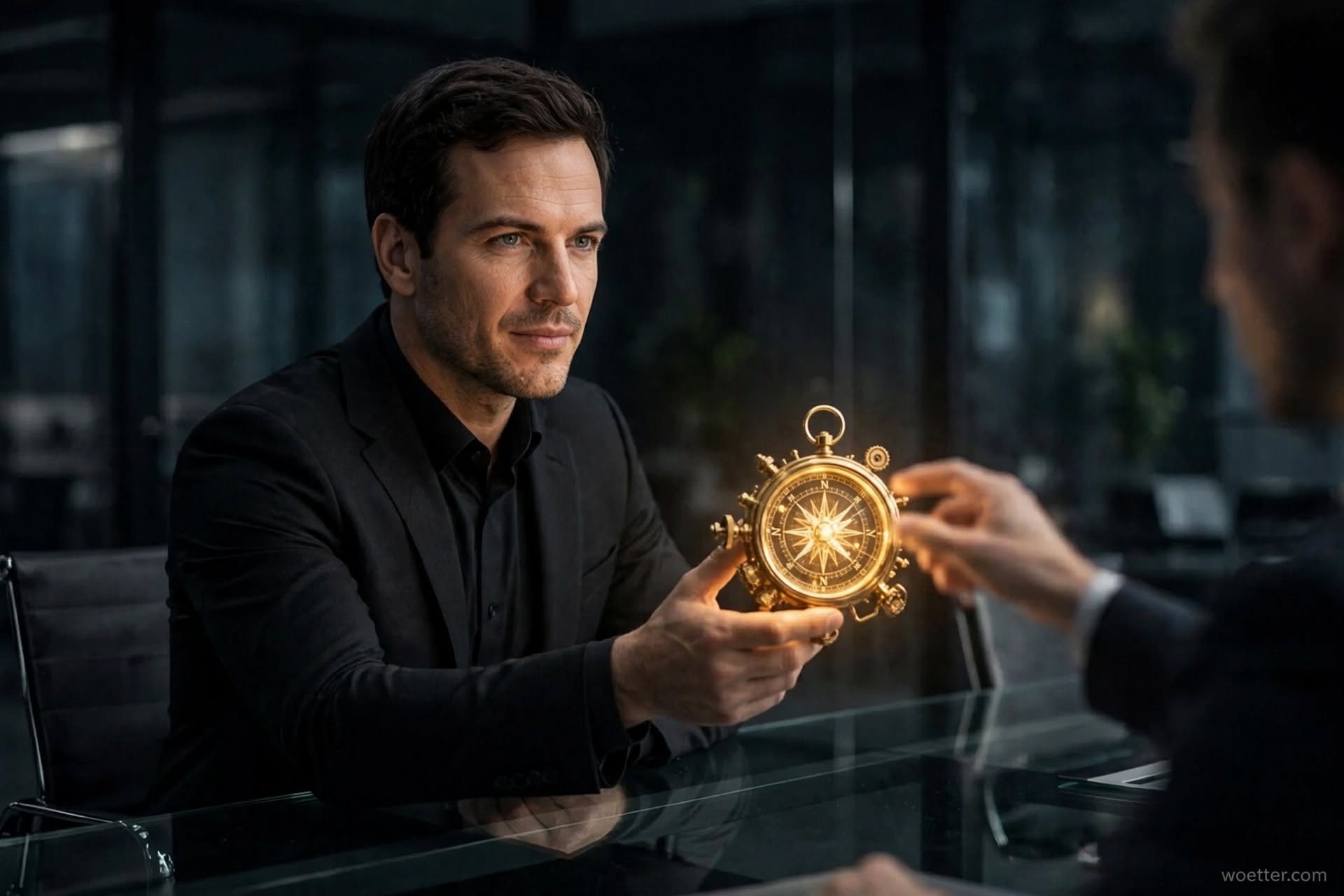
To correct The Hero's Mistake, the brand must undergo a profound psychological realignment, embracing the principle of transferring protagonism. In pop culture, the most perfect analogy is that the customer is Luke Skywalker, and your brand is Yoda. The customer is Katniss Everdeen, and you are Haymitch. The hero is never the strongest entity at the beginning of the story; they are vulnerable, confused, and frustrated. The guide, on the other hand, has already walked that path, possesses silent authority, tactical empathy, and is not seeking the spotlight. True power resides in the guide.

Assuming the archetype of the guide requires mastering two paradoxical forces: empathy and authority. If you demonstrate only empathy ('We understand your pain'), the customer will see you as a weak counselor, incapable of solving the problem. If you demonstrate only authority ('We have the best awards and the most advanced technology'), you revert to the Egocentric Bias and scare the customer away with arrogance. The precise intersection between understanding the customer's internal frustration and possessing the track record of competence to resolve it is what creates conversion.
The Internal Problem as a Value Lever
Companies that fail in the market generally try to sell solutions only for external problems. A plumber sells fixing a broken pipe (external problem). However, human purchasing decisions are primarily emotional and subsequently justified by logic. The broken pipe causes stress, domestic chaos, a feeling of loss of control, and disruption of routine (internal problem). Human beings buy the resolution of the internal problem. The Hero's Mistake blinds the company to the customer's psychological pain because the brand is too busy admiring the shine of its own tools.
When the brand assumes Yoda's posture, it diagnoses the external problem but aligns its communication to resolve the internal frustration. It stops talking about the stainless steel of the tool and starts talking about restoring peace to the customer's home before dinner. This reframing alters the perception of value. Solving external problems generates price-based transactions; solving internal problems generates blind loyalty and premium price elasticity.
Tactical Application: The Map and the Action
The guide not only understands and empathizes; they provide an unshakable plan. The brain, facing the risk of purchase, suffers from ambiguity. The Status Quo Bias dictates that it is safer to do nothing than to risk energy, time, and capital on an uncertain solution. To overcome inertia, the guide must present a clear bridge over the abyss of doubt.
In corporate practice, this means removing friction from the onboarding or purchasing process. The plan must be visual, preferably divided into three simple steps. The customer must see exactly what the microscopic next step is (schedule a meeting), what the transition phase is (we configure the system for you), and what the guaranteed final result is (a 30% increase in profit margins). This plan removes the customer from mental fog and provides absolute clarity.
Finally, the guide must issue a clear call to action and instill the risks of inaction. Due to Loss Aversion, the prospective pain of losing something is psychologically twice as powerful as the pleasure of gaining. If your brand is not clear about what it will cost the customer not to do business with you (wasted time, lost money, stagnation), the customer will lack the urgency needed to close the narrative loop.
The Hero's Mistake is not just a semantic flaw; it is a lethal error in business architecture. Brands that refuse to step down from the pedestal to illuminate the path for their customers will end up talking to themselves in an empty theater. The market generously rewards those who make the success of their customers the primary metric of their own value. Abandon corporate vanity. Provide the map. And let your customer lift the trophy.
Recommended Reading
- Building a StoryBrand by Donald Miller.
- Thinking, Fast and Slow by Daniel Kahneman.
- The 22 Immutable Laws of Marketing by Al Ries and Jack Trout.
Is your brand trapped in the Hero's Mistake and bleeding conversions? It is time to rebuild your narrative architecture based on behavioral economics and elite positioning. Subscribe to our newsletter to receive advanced market manipulation and authority mastery strategies directly in your inbox.