

The End of the Annoying Salesperson: A Strategic Essay on Authority and the Inverted Funnel
In classical corporate theory, traffic is the oxygen of a business. We believe that success depends on interrupting the user, capturing their click, and dragging them to an optimized sales page. However, when we apply the lens of behavioral economics to this model, we realize it generates immense psychological friction. The modern user has developed ad blindness and an aversion to interruptions. As we saw in the previous essay, the solution to circumventing the algorithm and consumer fatigue is zero-click marketing. But theory only has value when it survives the battlefield. Today, we will dissect how the surgical application of zero-click marketing and the authority trigger built a $5 million-a-year consulting empire, without spending a dime on advertising.

The Master Case Study: Justin Welsh's Empire
If you are not familiar with the North American B2B market, Justin Welsh is a former startup executive who decided to build a solo consulting and digital product business. His operation contradicts every traditional digital marketing playbook: he has no sales team, runs no Facebook or Google ads, and doesn't do exhausting "product launches."
How does he attract High-Ticket clients? He transformed LinkedIn and X (Twitter) into conversion machines purely using the concept of zero-click marketing.
The anatomy of his strategy is focused on the absolute delivery of native value. Most B2B companies post like this: "We just published an article on sales funnels. It is very important for your company. Click the link to read it!". The result? Three likes and a reach destroyed by the algorithm, which punishes the attempt to take the user off the platform.
Welsh's approach does the opposite. He applies the authority trigger by delivering the entire system right there.
The Anatomy of a Million-Dollar Post
Let's open the "black box" of how zero-click marketing works in practice. A strategic text has three invisible gears:
1. The Hook (Focus on the Problem, not the Product): Behavioral economics proves that the brain pays much more attention to the prevention of pain than to the promise of a gain. Welsh doesn't start by selling his consulting. He starts by naming the enemy. Example: "Most consultants fail because they try to sell time, not systems."
2. The Native Solution (Breaking the Expectation): Here the magic of zero-click marketing occurs. Instead of saying "read more on my website," he delivers the solution immediately. Example: "Here is the 3-step blueprint I used to productize my service: Step 1 [Detail], Step 2 [Detail], Step 3 [Detail]." The reader finishes the text and experiences what we call Cognitive Ease. They think: "Wow, I just learned something valuable in 30 seconds, without having to leave my feed or fill out forms."
3. The Authority Trigger (The Side Effect): By delivering the "gold" openly, he activates the authority trigger and reciprocity. The reader logically concludes: "If this professional gave me such a good action plan for free in a 300-character post, imagine the depth of his paid consulting?". The sale happens in the client's mind before the offer is even made.
The Logic of the Inverted Funnel
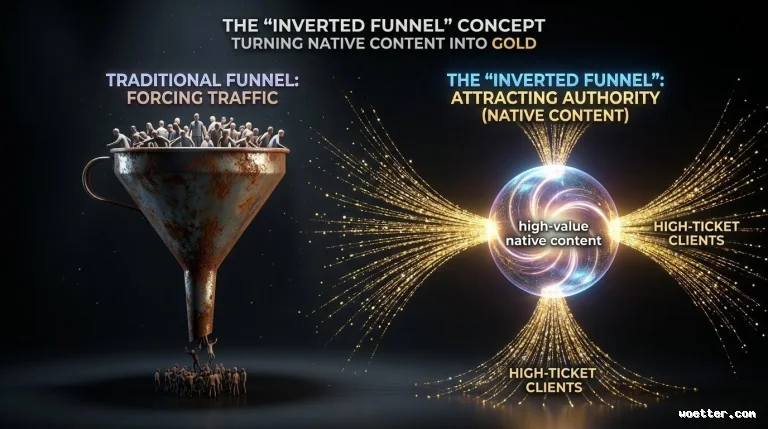
Why does this tactic eliminate the need for a sales team? Because it operates under the dynamics of the inverted funnel. In traditional marketing, we hide our best content behind a Landing Page to capture an email. In zero-click marketing, the content itself is the marketing.
Retention and Reach: Platforms love this content because it keeps the user logged in. The algorithm rewards your brand with viral reach.
Trust and Positioning: You stop being an "annoying corporate salesperson" and are positioned by the authority trigger as a respected expert.
Soft Sell: When you finally post a link (usually in the first comment), the conversion rate is absurd. Whoever clicks has already gone through the entire education process. The sale is practically done.
Implementation Framework: The Principle of Separation
How do you apply the inverted funnel to your business tomorrow morning, regardless of whether you sell software, tax consulting, or healthcare services? The secret is understanding the separation between information and execution.
If you are a tax attorney: Don't post "Check out the new law on the blog". Post a native carousel with "The 3 things that change in your corporate contract today with the new law".
If you are a nutritionist: Don't post "Schedule your appointment". Post the "Exact 3-day menu to detox the body".
The secret to zero-click marketing is not hiding your game. The secret is showing that you play so well that it is worth paying a premium to have you on the team. The golden rule that bulletproofs the profits of the greatest modern strategists is simple: Deliver the content. Sell the implementation. The client might read the recipe for free, but they will always pay the Chef to cook the main course.
📚 Recommended Reading
To master building empires based on content and silent authority:
"Company of One" - Paul Jarvis: The manifesto on how to build highly profitable, lean, and scalable businesses, very much aligned with Justin Welsh's operational model.
"Influence: The Psychology of Persuasion" - Robert Cialdini: Dive deep into the authority trigger and understand why the modern consumer blindly follows experts who solve problems before the financial transaction.
Strategic Conclusion
The internet has banned mediocrity. The tactic of hiding small pills of knowledge behind capture forms stopped working at the turn of the last decade. Today's market leaders understand that authority cannot be bought with paid media; it must be demonstrated in the public square. By adopting the inverted funnel, you stop chasing clients with tiring ads and start attracting them with extreme competence. Do not be afraid to give away your best material. The market will always generously reward those who solve problems brilliantly and transparently.
Do you want to stop begging for attention and start using the Inverted Funnel to attract high-value clients who arrive ready to buy? Subscribe to the newsletter in the field below, receive our weekly strategic essays, and discover how to master the algorithm and behavioral economics in favor of your cash flow.
