Case Study Summary: The Toyota Production System (TPS)
This case compares two opposing management philosophies that defined the global industry.
The Central Conflict:
- The Goal Model (GM/Ford): Focused on daily production quotas. Defects were ignored (“let through”) so as not to delay the goal, generating massive rework at the end.
- The Systems Model (Toyota): Focused on process quality. Taiichi Ohno implemented the “Andon Cord,” allowing any worker to stop the factory upon detecting an error.
- The Lesson: The focus on the system (fixing the root cause immediately) outperformed the focus on the goal (producing fast with defects), making Toyota the world leader in efficiency.

Imagine two factories in the 60s.
At the GM (General Motors) factory in Detroit, the atmosphere was war-like. The order was: “The line never stops.”
Managers had a Goal: produce 500 cars a day.
If a worker saw a door that didn’t fit right, he kept quiet. If he stopped the line to fix it, they wouldn’t hit the target. The car left with a defect and went to a gigantic “rework” yard to be fixed later (costing 10x more).
They hit the quantity goal, but lost the quality game.
On the other side of the world, at the Toyota factory, Taiichi Ohno did something unthinkable.
He installed a yellow cord above every worker: the Andon Cord.
The rule was: “If you see a problem—any problem, even a small one—pull the cord.”
When the cord was pulled, the entire factory stopped. Lights flashed. Production went to zero.
The Americans laughed. “These Japanese are crazy. Stopping the factory costs millions per minute! They’ll never hit the quota like that.”
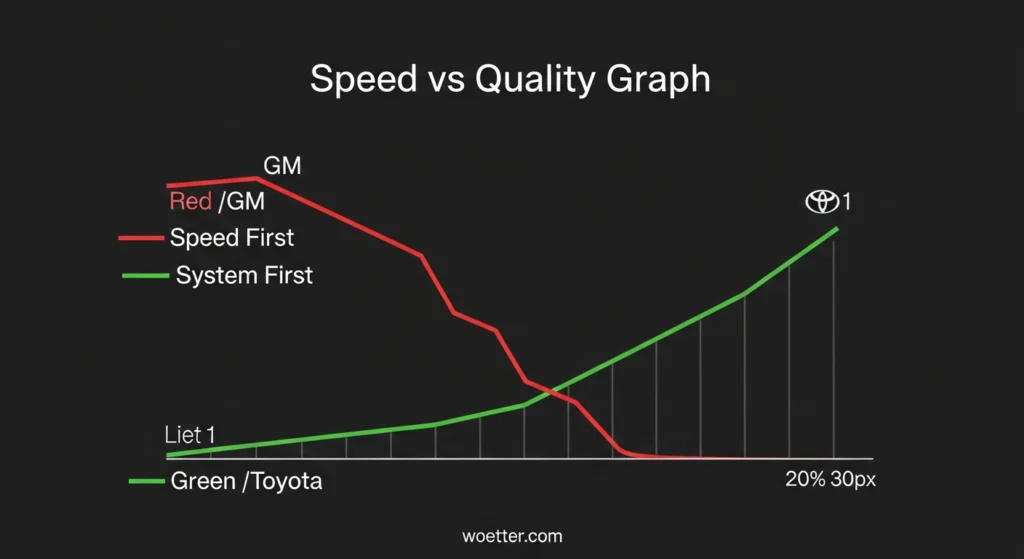
The Paradox of Slowness
In the short term, GM seemed faster. They delivered more (defective) cars per day.
Toyota seemed slow. The line stopped constantly.
But every time the line stopped, engineers ran not to “put out the fire,” but to fix the system.
- ”Why did the screw come loose?”
- ”Because the screwdriver is old.”
- ”Replace the screwdriver and change the process so this never happens again.”
Day after day, errors disappeared. The system cleaned itself.
In a few years, the Toyota line almost never stopped, because there were no more errors. The cars came out perfect. The cost plummeted. GM almost went bankrupt trying to fix their errors in after-sales.
My Analysis
What Toyota understood (and GM ignored) is that the Goal blinds the System.
When you tell your team: “We need to sell $100k at any cost,” they will sell.
But they will sell to bad clients, give excessive discounts, promise what they can’t deliver.
They hit the goal today, and you lose the company tomorrow with churn and lawsuits.
Your challenge for 2026:
Where is your “Andon Cord”?
Do you have the courage to tell your team: “Stop everything. This sales process is bad. Let’s fix the root cause before calling one more client”?
He who focuses on the goal (Output) runs on a flat tire.
He who focuses on the system (Input) stops, changes the tire, and arrives first.