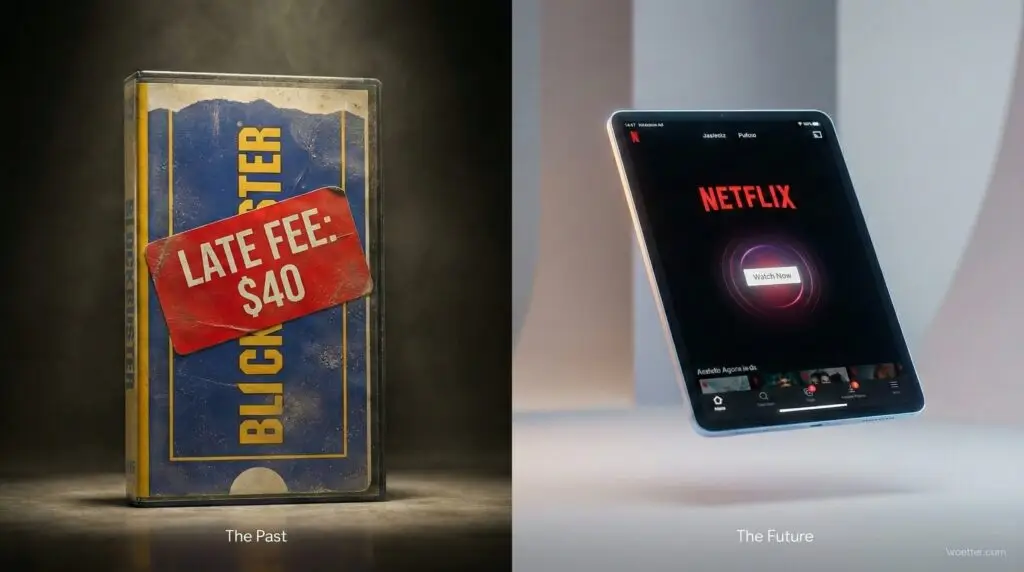
A $40 fine that changed the world 📼
Blockbuster was a giant. It had stores on every corner, the brand was strong, and the money was endless.
How did it lose to a mail-order startup?
The answer lies in Friction.
Blockbuster’s business model was “sadistic.” They made money when you failed.
About $800 million a year flowed into Blockbuster’s coffers purely as Late Fees.
They needed you to be late. Friction was the product.
This generated what we call “latent hatred.” You went to the store, but you went with fear. Fear of not finding the movie, fear of traffic, fear of the fine.
The Revolution Wasn’t Streaming (It Was Subscription)
When Netflix came along, it didn’t have streaming. It mailed DVDs (which is slow).
But it had a nuclear weapon: Zero Late Fees.
Reed Hastings created the “All You Can Eat” model. You paid a flat monthly fee and kept the movie as long as you wanted.
- Blockbuster: “Return in 2 days or pay a fine.” (Anxiety).
- Netflix: “Keep it as long as you want. When you return it, we send the next one.” (Peace).
The human brain, ruled by the Law of Least Effort, migrated en masse to the option that eliminated cognitive load.
The Coup de Grâce
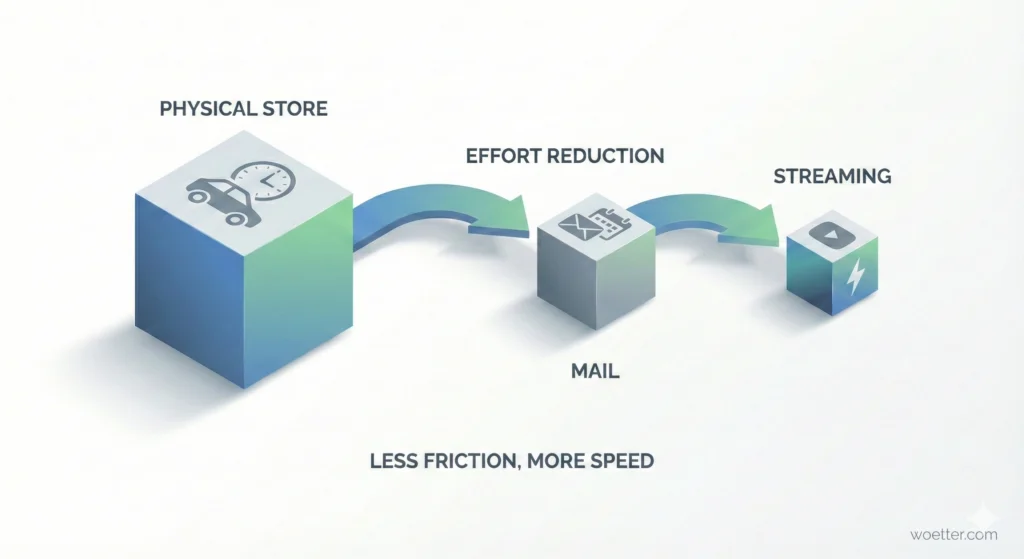
When the internet allowed Streaming in 2007, Netflix merely removed the last remaining barrier: physical friction.
Before: Wait for the mail (Days).
After: Click and watch (Seconds).
Blockbuster tried to copy, but it was too late. Their financial model was addicted to fines. They couldn’t let go of the $800 million in “free money” without going broke. Friction was the addiction that killed them.
My Analysis:
If your business model depends on making life hard for the customer (fines, hidden fees, difficult cancellation), you are a Blockbuster waiting for your Netflix.
Convenience is the most powerful force in the market.
Customers will always flow, like water, to the path of least resistance.
Your job is to be that path.
Do you have ‘late fees’ hidden in your process?
Audit it now!
The Friction Auditor: Download the checklist to identify barriers in the site/sales process. (🎁 exclusively for the newsletter’s subscribers)
Case Study Summary: Blockbuster vs. Netflix
This case illustrates how Friction (barriers to use) can destroy a dominant business.
The Conflict of Models:
- The Friction Model (Blockbuster): 16% of revenue ($800 million/year) came from Late Fees. Profit depended on punishing the customer’s mistake.
- The “Frictionless” Model (Netflix): Introduced the monthly subscription with no return dates. Eliminated the anxiety of the fine.
- The Final Blow (Streaming): Technology simply accelerated the process, eliminating the last physical friction (mail) and allowing instant consumption.