Case Study Summary: Apple (Lisa vs. iPod)
This comparison analyzes the evolution of Apple’s communication through the lens of StoryBrand.
The Clarity Contrast:
- The Failure (1983): For the Lisa computer launch, Apple ran a 9-page ad focused on technical specs (“We are the Hero”). The public didn’t understand and didn’t buy.
- The Success (2001): For the iPod launch, Steve Jobs ignored the gigabytes and focused on the benefit: “1,000 songs in your pocket” (“The Customer is the Hero”).
- The Lesson: Customers don’t buy specs; they buy a life transformation.
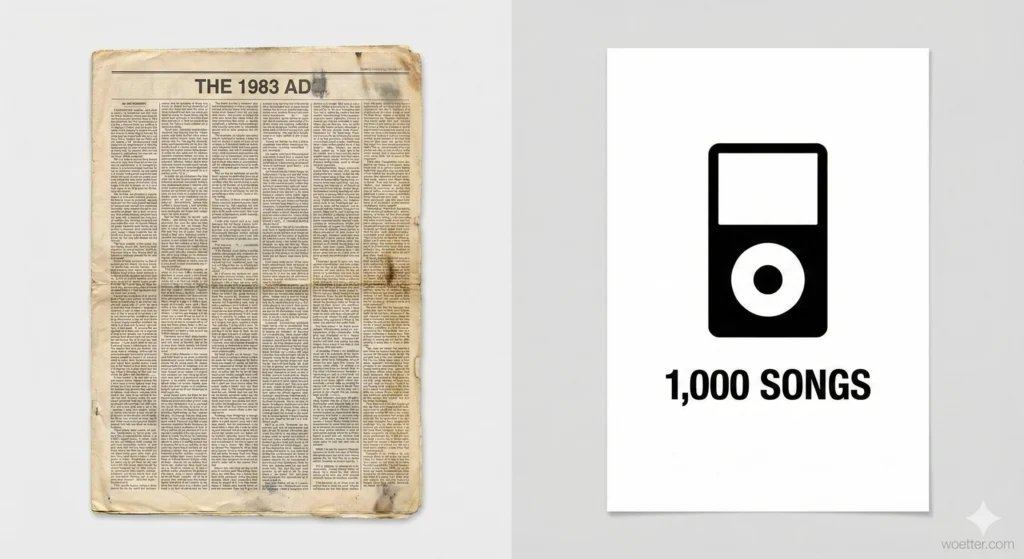
In 1983, Apple launched the “Lisa” computer. It was an incredible machine for its time.
To sell this marvel, the marketing team decided: “Let’s show them how smart we are.”
They bought space in the New York Times and published a nine-page ad.
Nine pages of dense text, talking about processors, bits, teraflops, and system architecture.
The message was: “Look at us. Look how complex our technology is.”
The result? Nobody read it. Nobody understood it. Nobody bought it.
It was one of Silicon Valley’s biggest commercial failures. Apple tried to be the Hero (the smartest one in the room), and the customer felt dumb.
The 2001 Turnaround: The Return of the Guide
Cut to 2001. Steve Jobs is back.
Apple is about to launch an MP3 Player.
Competitors were selling their players like this: “5GB storage, FireWire port, and 128kbps transfer rate.”
If Jobs had followed the 1983 strategy, he would have talked about the internal hard drive.
But he learned the lesson. He applied the Clarity Filter.
He got on stage and said one sentence: “1,000 songs in your pocket.”
Boom!
Why did it work? (StoryBrand Analysis)
- The Customer is the Hero: Jobs didn’t talk about the iPod. He talked about what the iPod did for you. Before, you had to carry a heavy CD binder. Now, you have freedom.
- The Product is the Tool: The iPod isn’t the protagonist. It’s the lightsaber that allows the hero to have infinite music.
- Zero Noise: He didn’t require the customer to know what a “Gigabyte” is. He translated the tech (5GB) into a benefit (1,000 songs).

My Analysis
The human brain has a primary function: to conserve calories.
When you hand over a 9-page text about “integrated solutions,” the customer’s brain says: “This looks hard. I’ll ignore it to survive.”
When you say “1,000 songs in your pocket,” the brain says: “I get it. I want it.”
For 2026, look at your marketing. Are you selling “Gigabytes” (features) or “Songs in Your Pocket” (transformation)?
Stop trying to sound smart. Try to be clear.
In the war for attention, clarity is the deadliest weapon.
Is your product an ‘iPod’ explained like a ‘Lisa’? Use our generator to simplify your message. (🎁 exclusive for the newsletter’s subscribers)