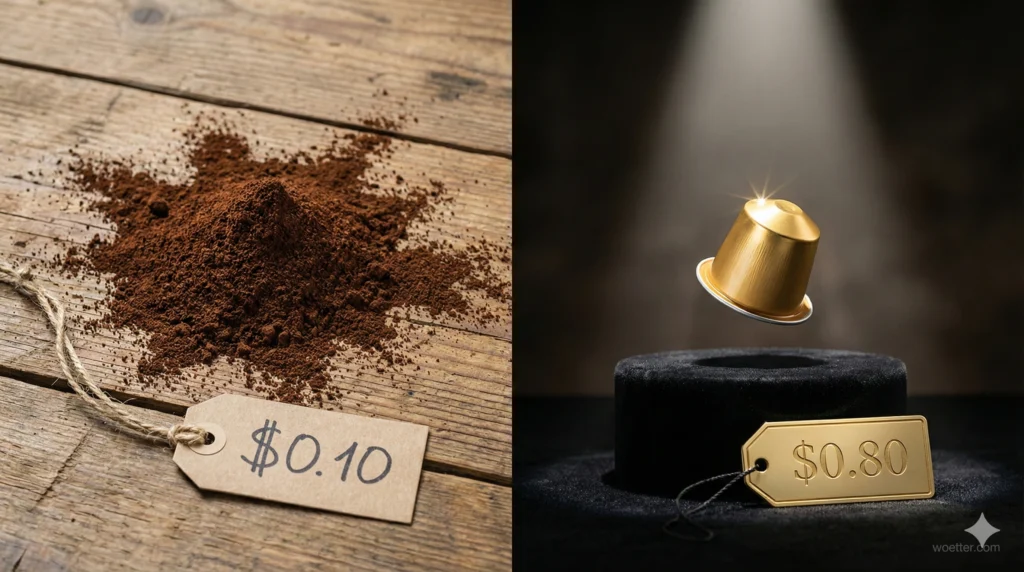
If you tried to sell a 1kg bag of coffee at the supermarket for $200.00, they would call the police. That is the price of illicit drugs or precious metals, not coffee.
However, millions of people happily pay this amount every day. They just don’t realize it.
Welcome to the world of Nespresso.
Nespresso is the ultimate example of what Rory Sutherland calls “Alchemy.” They took a cheap commodity and turned it into gold, just by changing how the price is presented.
The Illusion Mathematics
Let’s look at the cold numbers:
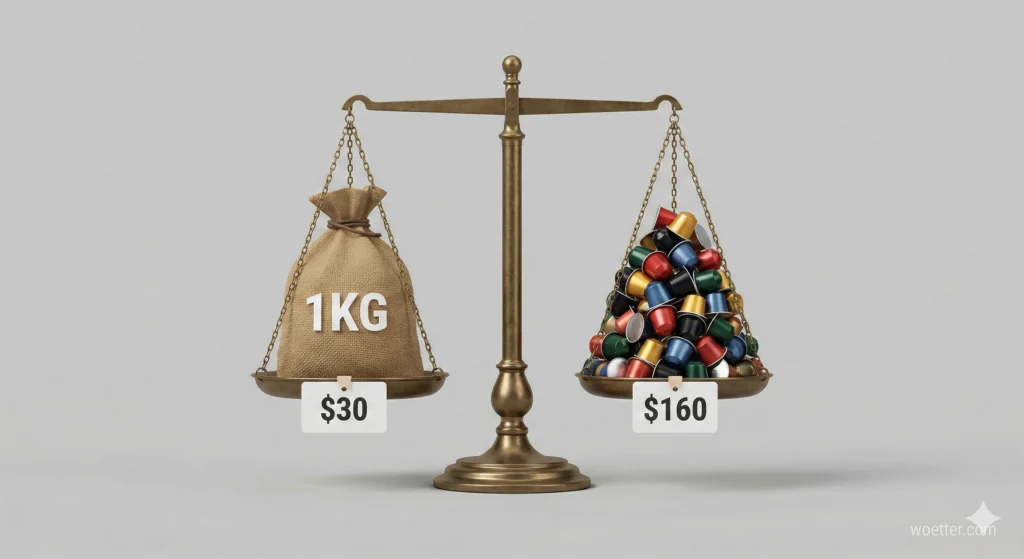
- A bag of premium coffee at the market (500g) costs about $15.00. That is $30.00 a kilo.
- A Nespresso capsule costs, on average, $0.80.
Inside that capsule, there are only 5 grams of coffee powder.
To make 1 kilo of Nespresso coffee, you need 200 capsules.
200 capsules x $0.80 = $160.00 a kilo.
You are paying 5 to 10 times more for the same product. Why don’t we feel robbed?
The Power of Reframing
Nespresso’s secret was changing the Reference Competitor.
If Nespresso sold “coffee powder,” we would compare it to Folgers or Peet’s. And compared to them, Nespresso would be robbery.
But Nespresso doesn’t sell powder. It sells “The Perfect Coffee Experience at Home.”
By changing the sales unit to the “single dose” (the capsule), it breaks the connection with the supermarket and creates a connection with the Coffee Shop.
- The brain thinks: “An espresso at Starbucks costs $4.00. This capsule costs $0.80. I’m saving $3.20!”
See the trick?
They changed the anchor.
- Old Anchor: Bag of powder ($15).
- New Anchor: Coffee Shop Espresso ($4).
Facing the new anchor, $160 a kilo seems “cheap.”
The Jewelry Aesthetic
To sustain this absurd price, Nespresso couldn’t sell the product in plastic bags.
They created the Boutique concept.
You don’t buy Nespresso on the shelf; you buy it in a store that looks like a jewelry store, with gloved attendants, tasting exclusive flavors as if they were rare wines.
The capsules are colorful and shiny like precious stones (rubies, emeralds, gold).
All of this serves to confirm to your brain that this is not just coffee. It is affordable luxury.
My Analysis
If you sell a product or service and customers complain that “it’s expensive,” the problem might be your unit of measurement.
Are you charging by the hour? By project? By kilo?
Try reframing:
- Don’t sell “English Lessons per hour” (Commodity). Sell “The package to pass the international job interview” (Investment).
- Don’t sell “Nutrition Consulting.” Sell “The 12-week summer body program.”
When you change the unit of measurement, you make comparison with the competitor impossible. And when there is no comparison, there is no price war.
Case Study Summary: Nespresso and Price Reframing
Nespresso transformed a low-margin commodity (ground coffee) into a high-margin luxury product through pricing psychology.
The Value Strategy:
- The Problem: Common coffee costs about $15.00 a kilo. It is hard to profit much selling powder.
- The Reframing: Nespresso changed the sales unit from “kilos” to “capsules” (single doses).
- The Math: A $0.80 capsule contains only 5g of coffee. This equates to over $160.00 a kilo.
- The Mind Trick: The consumer thinks it is cheap because they compare the capsule ($0.80) to Starbucks ($4.00), not to the supermarket bag ($0.20 per dose).