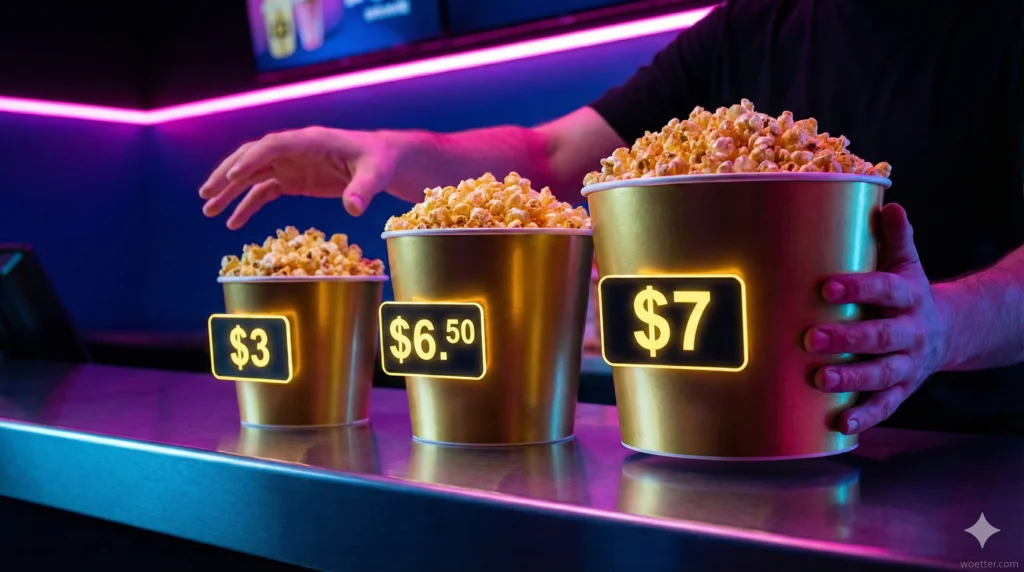
Let’s talk about Dan Ariely. He is a Behavioral Economics professor who proved, mathematically, that we are all irrational.
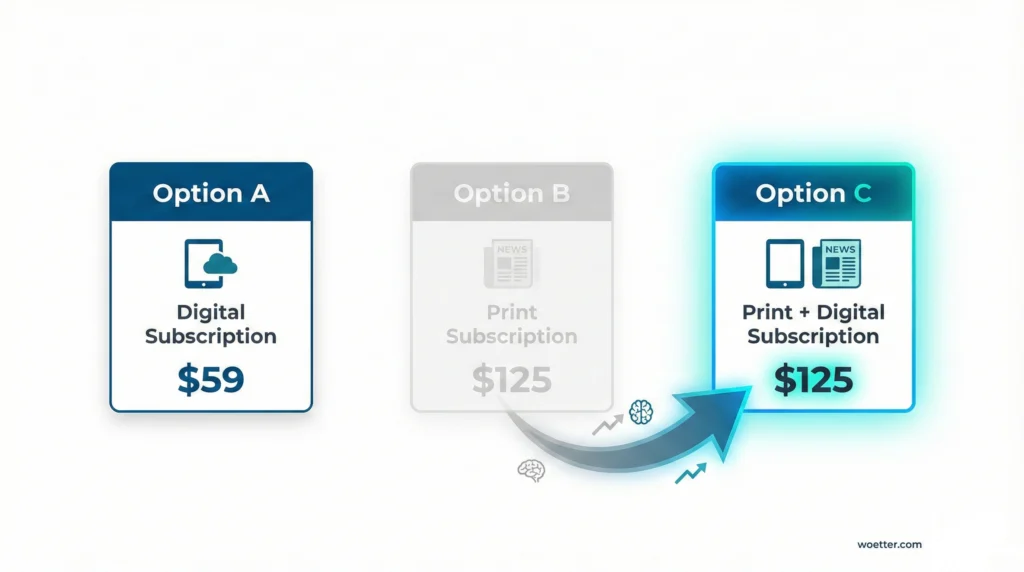
One day, he saw an ad for The Economist magazine that made no sense:
- Digital Access: $59.
- Print Magazine: $125.
- Digital + Print: $125.
Any sane person would look at option 2 and say: “Who is the idiot that would pay $125 just for the print version, if for the same price they get the digital one too?” Option 2 seemed useless. A mistake.
Ariely tested this with his students.
- With the “useless” option present: 84% chose the $125 combo (the most expensive sale).
- Removing the “useless” option: The overwhelming majority chose the $59 Digital option (the cheapest one).
Option 2 wasn’t a mistake. It was a Decoy. It existed only to make Option 3 a “no-brainer”. Without the decoy, $125 seemed expensive. With the decoy, $125 seemed “free.”
The Brain Hates a Vacuum
Humans don’t have an internal “price thermometer.” If I show you a part for an industrial machine and say it costs $5,000, you don’t know if that’s expensive or cheap. But if I place another identical part next to it costing $10,000, the first one instantly becomes a bargain.
This is Anchoring. The first number you see defines reality.
How to Apply This to Your Business (Without Selling Popcorn)
If you sell services or consulting, stop sending proposals with a single price. “My service costs $5,000.” The client will compare this price with $0 (not hiring) or with their nephew who does it for $500.
Create a choice architecture:
- The Price Decoy (The High Anchor): Create a “Premium/Enterprise” package that costs $15,000. Include high-effort items like “24/7 WhatsApp support.” The goal isn’t to sell this one. It’s to make the next one look cheap.
- The Target (What You Want to Sell): Your “Standard” package for $5,000. Now, $5,000 isn’t expensive. It’s “one-third the price of Premium, with almost the same benefits.”
- The Value Decoy (The “Floor”): A “Basic” package for $4,500. It is so close to the Standard price, but with so much less stuff, that the client thinks: “For $500 more I get the full package. I’m a genius.”
The Strategist’s Lesson
Pricing isn’t math. It’s psychology. The value of something changes depending on what is next to it. If you want to sell the $100 wine, put a $400 one at the top of the menu. If you want to sell the large popcorn, create the medium one.
Stop letting your client compare your price with the competitor. Make them compare your price with YOUR prices.
What is the Decoy Effect?
In behavioral economics, the Decoy Effect is a cognitive bias where the introduction of a third “asymmetrically dominated” option (the decoy) alters consumer preference between two other options, making the more expensive option appear more advantageous.
How to Apply Anchoring:
- The Problem: The human brain cannot judge absolute value (e.g., “Is this worth $100?”). It only judges relative value (“Is this cheaper than that?”).
- The Strategy: Never present a price in isolation. Create a “Decoy” (an expensive product or one with worse cost-benefit) solely to serve as an anchor and make your main product (the “Target”) irresistible.