The Difference Between Goals and Systems
According to James Clear (author of Atomic Habits) and Scott Adams, there is a fundamental difference in productivity:
Key Definitions:
- Goals: The desired end result (e.g., “Make $1 million”). The focus is on the future. The problem is they create a binary mindset of “failure” until the moment of achievement.
- Systems: The daily processes that lead to the result (e.g., “Make 5 sales calls a day”). The focus is on the present. Systems ensure constant progress, regardless of motivation.
The Golden Rule: “You do not rise to the level of your goals. You fall to the level of your systems.”
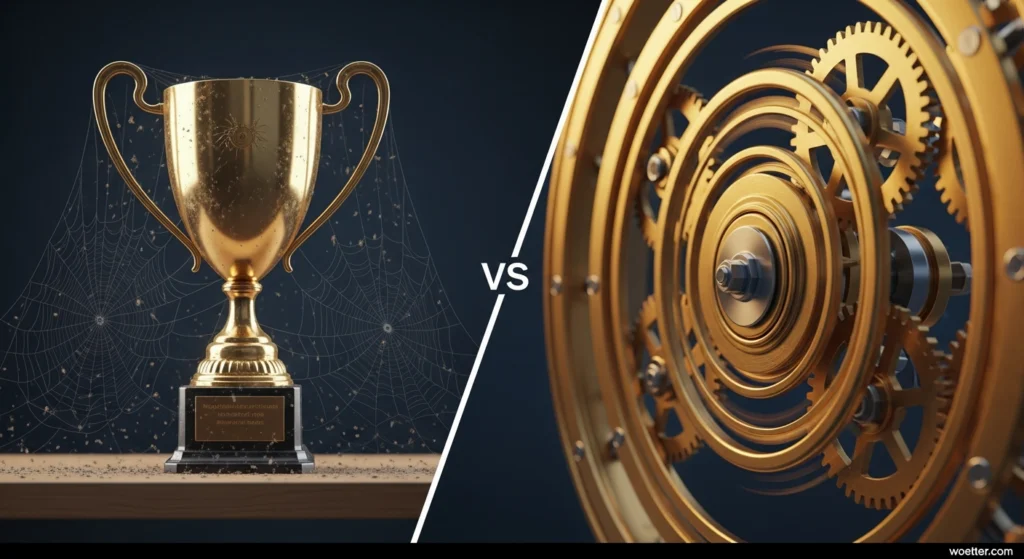
Let’s start with an uncomfortable truth: Winners and Losers have exactly the same goals.
Every athlete at the Olympics has the goal of winning Gold.
Every failed entrepreneur had the goal of becoming a millionaire.
If the goal is the same for both sides, it cannot be the differentiator for success.
What separates those who make it from those who fall by the wayside isn’t the “what” (the objective), it’s the “how” (the system).
The Problem with “Goal Setting” (The Binary Trap)
The traditional goal model, which corporations love, has a serious flaw: it puts you in a state of permanent failure.
Let’s say your goal is “Run a Marathon.”
- Today: You didn’t run. (Failure).
- Tomorrow: You trained, but haven’t run the marathon yet. (Failure).
- 3 months from now: You ran 18 miles. (Still failure).
You only allow yourself to be happy for 5 minutes at the finish line. And then? Then comes the void and anxiety for the next goal (the “Arrival Fallacy”).
Furthermore, goals depend on Willpower. And willpower is like your phone battery: it drains throughout the day. By 7 PM, when you’re tired, your goal loses to the couch.
The Solution: Systems Thinking
Scott Adams (creator of Dilbert) says: “Goals are for people who want to win once. Systems are for people who want to win repeatedly.”
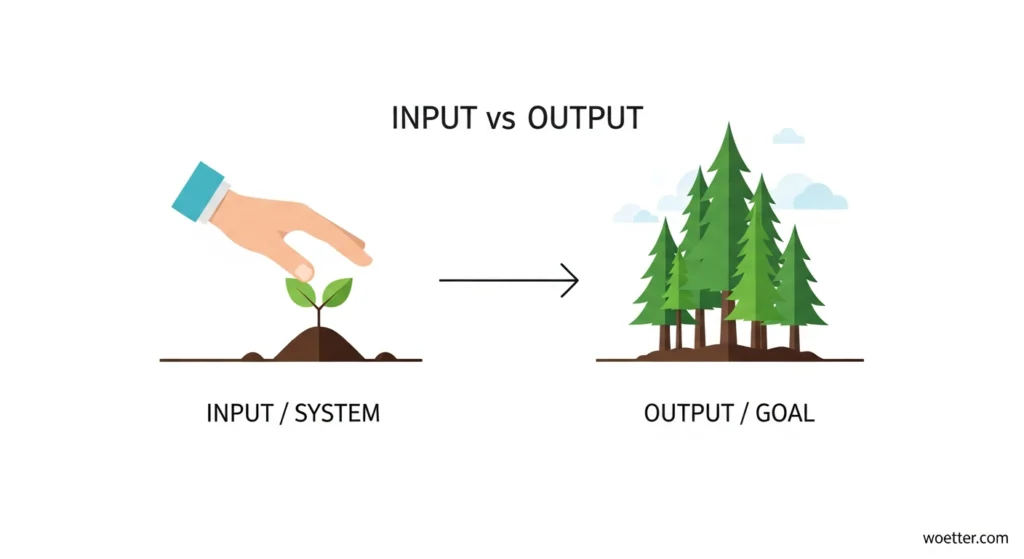
The System focuses on Input (what you control), not Output (what you desire).
Practical Example (Personal Life):
- Goal: Lose 20 lbs. (You don’t control your metabolism today).
- System: Eat vegetables at every meal. (You control what you put on your plate right now). If you follow the system, the weight is a mathematical consequence.
Practical Example (B2B Business):
- Goal: Close $100k in sales this month. (Depends on the client saying yes).
- System: Do 5 presentation meetings per day. (Depends only on you).
How to Install a System in 2026
Stop looking at the scoreboard. The scoreboard takes care of itself if you play the ball well.
For every goal you wrote in your plan, translate it into a repeatable daily action.
- Identify the Output: (e.g., Write a book).
- Identify the Input: (e.g., Write 500 words every morning at 07:00 AM).
- Forget the Output: Focus only on not breaking the Input chain.
The goal gives you direction (the compass north). The system gives you progress (the oars of the boat).
You can have the best compass in the world; if you don’t row every day, you’ll die in the middle of the ocean.
Happy 2026. Now let’s go to work!