What is a “Keep, Kill, Double” Marketing Audit?
It is a strategic year-end review method focused on financial efficiency, used to eliminate waste and scale results.
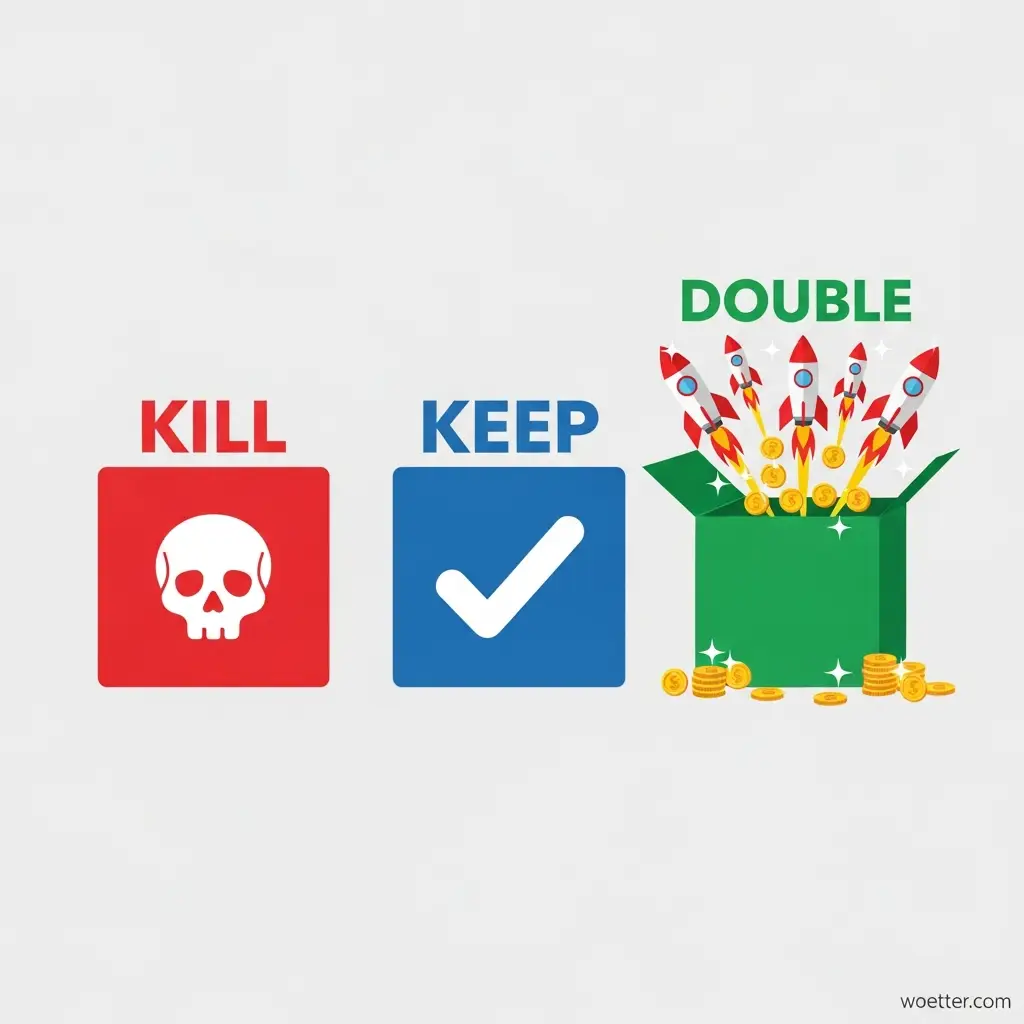
The Decision Framework:
- Kill: Terminate “zombie” projects that consume resources without generating measurable ROI or learning, eliminating budget inertia.
- Keep: Continue with “bread and butter” operations that ensure stability and consistent cash flow.
- Double: Identify the 20% of actions that generated 80% of the results and double the investment in them for the next year.

Do you know what the biggest enemy of your growth in 2026 is?
It’s not the economy. It’s not the competitor.
It is Inertia.
December arrives, and most managers commit the cardinal sin of planning: taking this year’s budget and just “renewing” it for next year.
“Oh, we always posted 3 times on Instagram and sent an offer email on Friday. Let’s continue.”
This creates the phenomenon of Zombie Projects.
These are initiatives that aren’t alive (don’t bring ROI, don’t bring customers), but aren’t dead either (they keep consuming budget and team hours). They walk the halls of your company eating brains.
Today, we are going to perform an autopsy. We are going to apply the Keep, Kill, Double framework.
1. KILL: The Courage to Pull the Trigger
This is the hardest part. You need to look at your spreadsheet and identify what didn’t work.
- That YouTube channel that gets 50 views per video and costs 10 hours of editing? KILL.
- That influencer partnership that brought zero trackable sales? KILL.
- That automation tool no one has logged into for 3 months? KILL.
Don’t fall for the “Sunk Cost Fallacy” (which we talked about in Week 2). It doesn’t matter how much you’ve already spent. If it’s a zombie, kill it. The money you save here will fund your growth.
2. KEEP: The Bread and Butter
Not everything needs to be genius. Some things just need to work.
Identify what brings consistent results, even if not spectacular.
- The weekly newsletter that keeps the audience warm.
- The Google Ads that bring leads at an acceptable cost.
Here, the rule is: Optimize, but don’t invent. Ensure the machine keeps running to pay the bills.
3. DOUBLE: The 20% Bet
Here is the secret to exponential growth.
Look at the 2025 data. Where is the Pareto Principle? What was the single thing you did that brought disproportionately good results?
- ”Wow, that carousel about X went viral and brought 5 clients.”
- ”That email focused on Y converted 10%.”
Take the money you saved by killing the Zombies and double down here.
If it worked small, it will work big. In 2026, don’t distribute your budget equally. Pour gasoline on the fire.
The Final Warning: Beware of Vanity
To do this audit, you need the right glasses.
If you audit looking at “Likes” and “Followers,” you will keep the zombies alive. Zombies love likes.
Audit looking at Business Metrics:
- CAC (Customer Acquisition Cost): How much did it cost to bring a customer through this channel?
- LTV/Retention: Did the people who came through this channel stay or leave?
Marketing isn’t for winning applause at the year-end meeting. It’s for putting money in the bank.
Pick up the sword. Kill the zombies. Happy 2026!
Need help deciding what to kill? Download our audit spreadsheet. (available just for the newsletter’s subscribers)