
In the digital world, the most valuable currency isn’t Bitcoin. It’s your user’s cognitive energy.
As strategists, we fall into the trap of thinking that to sell more, we need to add things (bonuses, videos, copy).
Behavioral science says the opposite: explosive growth comes from subtraction.
The number one enemy of your revenue has a name: Friction.
The Law of Least Effort (Kahneman)
To understand why friction kills sales, look at biology. The brain consumes 20% of our energy. For survival, it follows the Law of Least Effort.
Daniel Kahneman (Nobel in Economics) explains that we have two systems:
- System 1: Fast and automatic (Buy with 1-Click).
- System 2: Slow and effortful (Remembering the password for that account created in 2019).
When your site asks “Create a password with 12 characters and an Egyptian symbol,” you force the brain to engage System 2. This generates physical pain. The brain activates rejection mode, and the customer closes the tab.
The $300 Million Button (Jared Spool)
There is no greater example than the case documented by Jared Spool.
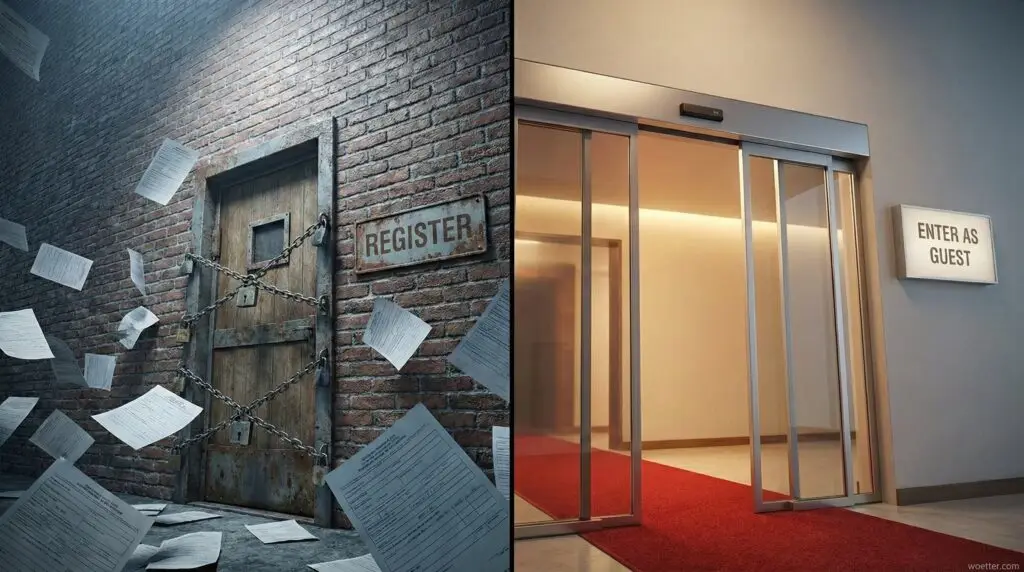
An e-commerce giant was losing millions. The flow was: Cart -> “Register” Button -> Purchase.
The company’s logic was: “We want them to create an account to make returning easier.”
The customer’s logic was: “I just want to buy a sock. I don’t want a relationship.”
Spool made a single change. He replaced the “Register” button with “Continue as Guest” and added the phrase: “You do not need to create an account to make purchases”.
The Result:
Sales went up 45% the next month.
In the first year, this text change generated an extra $300 million.
They were charging a “patience tax” that customers didn’t want to pay.
The Technology Paradox
Today, we have technology to be invisible (FaceID, Apple Pay), yet companies insist on creating “digital sludge.”
Asking for ID numbers to download an ebook. Asking for Zip Codes before showing the price.
Every extra field in the form isn’t more data. It’s one less sale.
If Jeff Bezos patented “1-Click” buying in 1999, it was because he understood before everyone else: the shortest distance between desire and possession must be a single gesture.
The Lesson: Radical Simplification
Your job isn’t to seduce the customer into jumping over hurdles. It is to tear down the walls.
Do a friction audit today:
- How many clicks to payment?
- Is the price hidden?
- Does the form have optional fields? (Delete them).
Be Frictionless. In a world of scarce attention, the path of least resistance is the only path that leads to success.
How many clicks do your customers take before quitting?
Take the test now!
The Friction Auditor: Download the checklist to identify barriers in the site/sales process. (🎁 exclusively for the newsletter’s subscribers)
What is Friction in Sales and UX?
Friction is any psychological or operational resistance that prevents a user from completing an action. Based on Daniel Kahneman’s “Law of Least Effort,” friction activates the brain’s System 2 (slow and analytical), causing drop-off.
The $300 Million Button Case:
Jared Spool discovered that forcing customers to “Register” before purchasing caused massive cart abandonment. By changing the button to “Continue as Guest,” revenue increased by 45% ($300 million in the first year).
The Lesson:
The best marketing isn’t adding value; it’s removing barriers.